 blog
7 Long Term Food Storage Containers Reviewed for 2026
Last Updated: November 4, 2026
Quick Summary
The best food storage containers for 2026 combine food-grade material, an airtight seal, and thick walls that survive years of handling. Food-grade buckets with gamma-seal lids suit bulk rice, wheat, beans, and oats, while heat-sealed Mylar bags with oxygen absorbers give the longest shelf life for dry goods you will not open for a year or more.
- Buy new food-grade buckets only; a food-grade bucket that held paint or soap is no longer food-safe.
- Fill containers to roughly 80-90 percent to leave headspace for an absorber and the lid.
- White rice stored in Mylar with an absorber lasts roughly 10-15 years, versus 2-3 years in glass.
- Match oxygen absorbers to container volume using the manufacturer's sizing chart rather than guessing.
- Keep the heaviest containers on the bottom and inspect gaskets once a year.
Table of Contents
- What to Look for in Long Term Food Storage Containers
- Quick Comparison: Container Types at a Glance
- Food-Grade Buckets for Food Storage: The Backbone of Any Pantry
- Mylar Bags for Long-Term Food Storage: Pros, Cons, and Best Uses
- Oxygen Absorbers for Food Storage: How Much and When to Use Them
- Long-Term Food Storage Shelf Life by Food Type and Container
- Cleaning, Reuse, and Durability: What Holds Up Over Time
- Build Your Container Kit at Survive Nation
- Frequently Asked Questions
What to Look for in Long Term Food Storage Containers
A long term food storage containers review in 2026 comes down to three things: the material touching your food, the seal keeping air out, and whether the container survives years of handling. Get those right and your pantry holds up. Get them wrong and you lose the whole investment.
A common pattern is that people buy cheap containers, store rice or beans for a year, then open the lid to find stale grain or pests inside. The container failed, not the food.
Here is the short version before we go deeper:
- Material: food-grade high-density polyethylene or sturdy Mylar, never recycled or non-food plastic.
- Seal: a rubber gasket or heat-sealed closure that blocks air and moisture.
- Oxygen control: an absorber sized to the container volume, not guessed.
The rest of this guide breaks down each container type, what it stores best, and how to build a kit that lasts.
Food-Safe Materials and Chemical Migration
Food-safe means the plastic or liner is rated to touch food and will not leach chemicals into it over time.
What most guides miss is that "food-grade" describes the original resin, not the bucket's history. A food-grade bucket that held paint or soap is no longer food-safe.
Watch out: black or opaque recycled buckets sold at hardware stores are often not rated for food. Use them for tools, not grain.
Airtightness, Moisture, and Pest Protection
Airtightness is the single biggest factor in how long stored food lasts. Oxygen and moisture drive spoilage, and insects can enter through gaps.
A common mistake is trusting a lid that snaps on but has no gasket. Those lids keep dust out and nothing else.
Temperature and humidity sit alongside the seal. For deeper guidance on keeping stored food cool, our guide on how to keep food cool covers temperature and moisture control in detail.
Quick Comparison: Container Types at a Glance
This comparison covers usable volume, opening width, stackability, and what each container type does well and poorly.
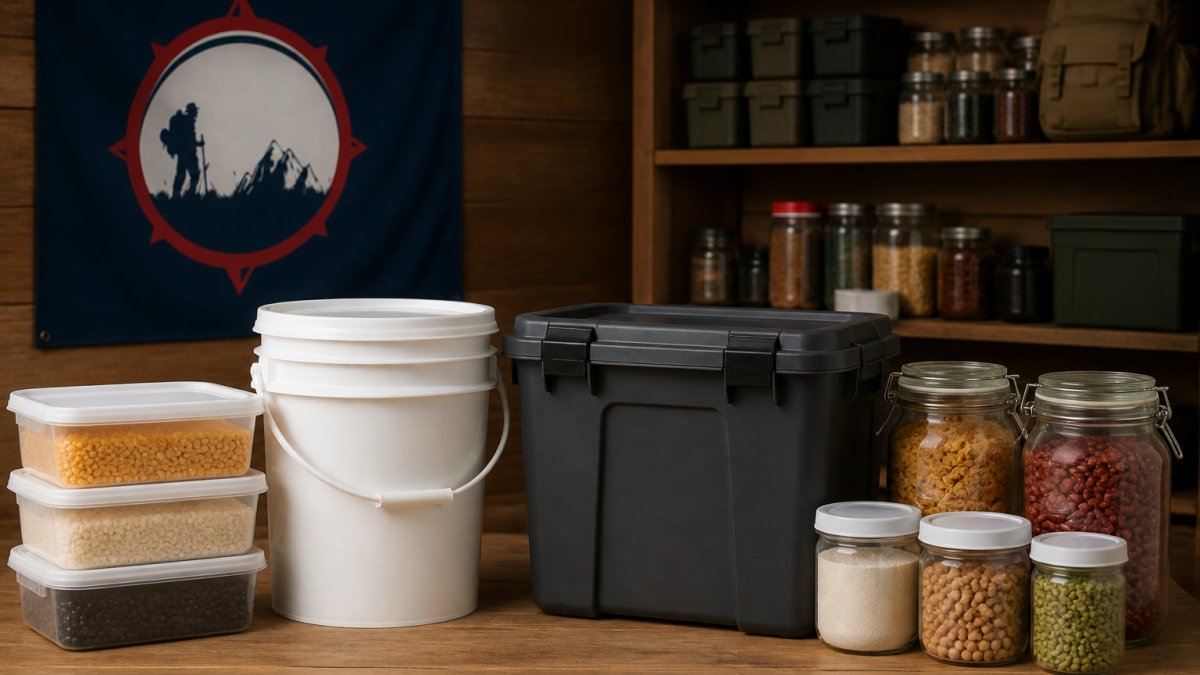
| Container | Typical usable volume | Opening / access | Stackable | Airtight mechanism | Best for | Main weakness |
|---|---|---|---|---|---|---|
| Food-grade bucket (5 gal) | About 4.5-5 gal of grain; roughly 35-40 lb of rice or beans | Wide top; gamma-seal lid adds a screw-off center | Yes, with lids on | Gamma-seal lid with gasket, or original lid plus Mylar liner | Bulk rice, wheat, beans, oats | Heavy when full; hard to pour without a scoop |
| Food-grade bucket (2-3.5 gal) | About 1.5-3 gal | Wide top | Yes | Same as above | Smaller households that rotate stock | Less capacity per shelf inch |
| Mylar bag (1 gal) | About 1 gal; holds roughly 5-7 lb of rice | Heat-sealed flat top; cut to open | Flat when empty; not rigid | Heat seal plus oxygen absorber | Dry goods you will not open for a year or more | Needs a sealer; punctures easily |
| Mylar bag (5 gal) | About 5 gal; sized to line a bucket | Heat-sealed; often used as a bucket liner | Only inside a rigid container | Heat seal plus absorber | Long-haul bulk grain | Handling and folding take practice |
| Glass jar (quart) | About 1 qt; roughly 2 lb of rice | Wide-mouth or regular-mouth lid | Yes, if lids are flat | Gasket lid or two-piece canning lid | Spices, daily-use grains, small quantities | Breakable; heavy per volume |
| Vacuum-sealed bag | Portion-sized | Cut to open | Flat | Vacuum seal | Compact portions, freeze-dried foods | Not reusable; limited protection from punctures |
| Airtight plastic bin | Varies widely; check the stated volume | Usually wide latch lid | Yes | Gasket plus latch | Pet food, bulk staples you open often | Gasket wears; less pest-proof than a bucket |
A few practical notes that the table cannot show:
- Capacity is not the same as usable volume. A five-gallon bucket does not hold five gallons of grain once you leave headspace for an absorber and a lid. Filling to roughly 80-90 percent leaves room for the absorber and helps avoid crushing the contents.
- Opening width matters more than total size. A narrow-mouth container that holds a lot is frustrating to scoop from. Wide-top buckets and wide-mouth jars win on daily usability.
- Stackability depends on the lid. Buckets stack only when the lid is designed for it; glass jars stack only with flat lids. Plan shelf height around the stacked footprint, not the single-container height.
This table is a starting point. For a wider look at emergency food options that pair with these containers, our roundup of the best emergency food storage options covers the food side of the equation.
Food-Grade Buckets for Food Storage: The Backbone of Any Pantry
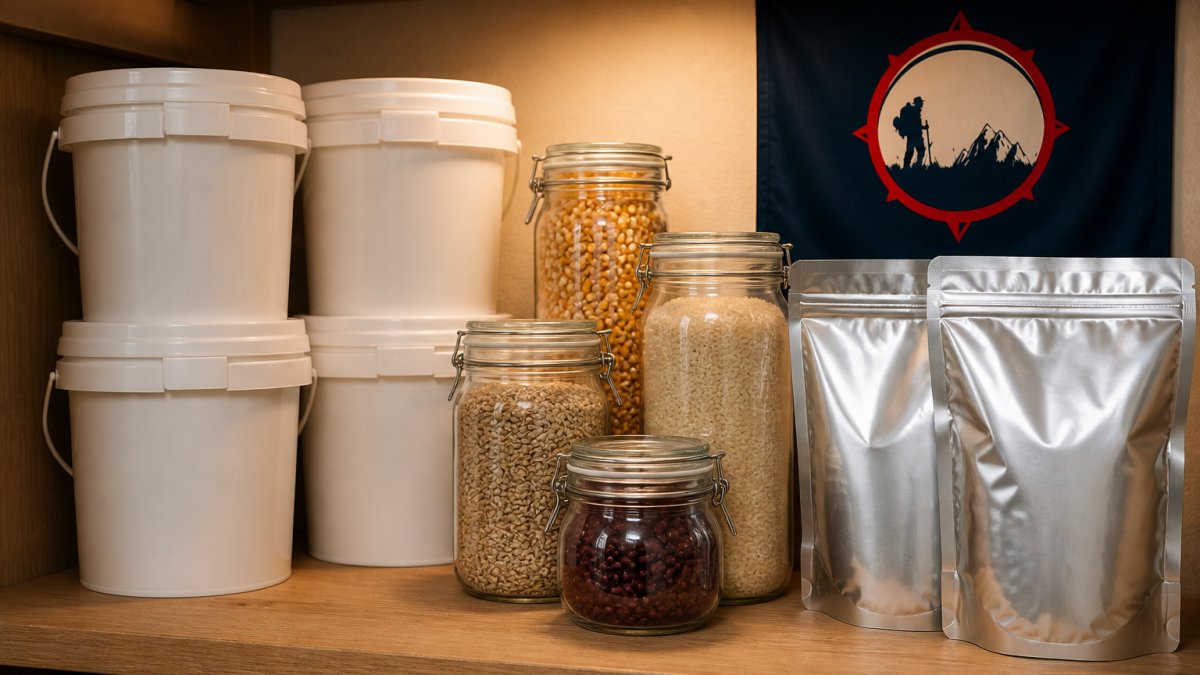
Food-grade buckets are a common choice for pantry storage. They hold large volumes, stack neatly, and take a gamma-seal lid that turns a standard bucket into an airtight container.
Buy buckets rated food-grade, sized to what you actually rotate through. A five-gallon bucket holds a lot of grain, but if you cook rice twice a week, a smaller bucket you refill often beats a giant one that sits for years.
The man is American.
Best for: bulk dry staples and households that rotate stock regularly. Skip if: you need small, grab-and-go portions.
Mylar Bags for Long-Term Food Storage: Pros, Cons, and Best Uses
Mylar bags are widely used for long-term dry storage. They block light, oxygen, and moisture when heat-sealed, and they pack flat when empty. For anyone storing food for years rather than months, Mylar is a strong option.
The catch is handling. Mylar needs a heat sealer, careful folding, and protection from punctures. A bag that gets nicked in a crowded tote will leak air and lose its advantage.
- Pros: excellent oxygen and light barrier, compact, long shelf life.
- Cons: requires a sealer, can puncture, not reusable once cut open.
- Best use: dry goods you will not touch for a year or more.
Oxygen Absorbers for Food Storage: How Much and When to Use Them
Oxygen absorbers remove the oxygen inside a sealed container, which slows spoilage and kills insect activity. They only work inside an airtight container.
Match the absorber to the container volume and the food type. Dense foods like rice and beans need more; light, fluffy foods need less.
Watch out: more absorbers is not better. Oversized absorbers can pull the bag tight enough to crush delicate contents or pull moisture where you do not want it.
Long-Term Food Storage Shelf Life by Food Type and Container
Shelf life depends on the food and the container working together.
| Food | Bucket + absorber | Mylar + absorber | Glass jar | Key caveat |
|---|---|---|---|---|
| White rice | Roughly 8-10 years | Roughly 10-15 years | Roughly 2-3 years | Brown rice is far shorter because of its oil content; treat it as a months-to-a-couple-of-years food |
| Dry beans | Roughly 8-10 years | Roughly 10-15 years | Roughly 2-3 years | Older beans take longer to soften; rotate stock |
| Rolled oats | Roughly 5-8 years | Roughly 8-10 years | Roughly 1-2 years | Oats absorb odors; keep away from strong-smelling goods |
| Pasta | Roughly 5-8 years | Roughly 8-10 years | Roughly 1-2 years | Egg pasta and flavored pasta shorten the range |
| Flour | Roughly 3-5 years (white) | Roughly 5-8 years (white) | Roughly 6-12 months | Whole-grain flour goes rancid faster; freeze or use first |
| Freeze-dried meals | Not ideal | Roughly 10-25 years | Not ideal | Pouch integrity matters more than the outer container |
| Sugar, salt | Indefinite in a sealed bucket | Indefinite | Indefinite | Moisture causes clumping, not spoilage |
What drives the differences:
- Fat content is the shelf-life limiter. Whole grains, brown rice, nuts, and whole-grain flour carry oils that oxidize and turn rancid. No container stops that clock; it only slows it. White rice and white flour last far longer because the oil-bearing bran is removed.
- Moisture is the second limiter. A container that lets humidity in will spoil grain faster than one that blocks it. That is why a gasketed lid or a heat-sealed Mylar liner matters more than wall thickness.
- Oxygen absorbers extend the ceiling, not the floor. They help most with dry goods in a truly airtight container. In a loose-lidded bucket they do little, and oversized absorbers can pull the bag tight enough to crush delicate contents.
Freeze-dried foods deserve their own note. They pair best with Mylar and absorbers, and our guide to the best freeze-dried food options for families shows which foods hold up longest in each container type.
Watch out: treat any single-number shelf-life claim as a best case. The realistic range depends on your storage temperature, humidity, and how often you open the container.
Cleaning, Reuse, and Durability: What Holds Up Over Time
Reuse is where cheap containers reveal themselves. A thin bucket cracks at the rim after a few openings. A gasket dries out and stops sealing.
Clean and dry every container fully before refilling. Residual moisture is the enemy, and a damp bucket will spoil a fresh batch of grain fast.
A common mistake is stacking heavy buckets on weak bins. Weight crushes thin walls over time.
Build Your Container Kit at Survive Nation
A complete kit mixes container types rather than betting on one. Buckets for bulk staples, Mylar for long-haul dry goods, jars for what you use daily, and absorbers sized to each. Build it in layers and rotate what you store.
At Survive Nation, we stock food storage gear built for real emergencies, backed by a fast, user-friendly shopping experience and a customer service team that answers questions before you buy. Browse our long-term food storage selection to match containers to your pantry, or start with affordable long-term food storage kits if you are building a full setup from scratch.
Start with the containers that fit how you actually cook and store. Then size your absorbers and seals around them.
Frequently Asked Questions
Are food-grade buckets good for long-term food storage?
Yes. Food-grade buckets made from HDPE are a common choice for dry goods like rice, wheat, and beans. Pair them with Mylar bags and oxygen absorbers to block moisture, light, and oxygen. Use only buckets marked food-grade, and avoid buckets that previously held chemicals or cleaners. Store in a cool, dark place, and rotate contents every few years.
Do you need Mylar bags inside food storage buckets?
Not always, but they help. Mylar bags for long-term food storage block light and oxygen when sealed with an oxygen absorber, which extends shelf life beyond what a bucket alone provides. For foods you plan to store more than five years, use both. For shorter storage or foods you rotate often, a food-grade bucket with a tight lid can be enough.
How long can food last in airtight storage containers?
Long-term food storage shelf life depends on the food and container. White rice, dry beans, and wheat stored in Mylar with oxygen absorbers can last 10 to 25 years. Foods with higher fat content, like nuts or whole grains, keep for shorter periods. Always label containers with the date and rotate stock so older food gets used first.
What should you look for in a long-term food storage container?
Look for food-safe materials, a tight seal, and protection from light and pests. Food-grade buckets, Mylar bags, and oxygen absorbers for food storage cover the basics. Check capacity and dimensions so containers fit your shelves, and confirm the lid seals fully. Durability matters too: rigid containers resist rodents better than thin plastic or cardboard.
Building a pantry that holds up for years takes the right containers, the right seals, and a plan you will actually maintain. Survive Nation carries food storage supplies and preparedness gear at affordable prices, with years of industry experience behind every recommendation and a shopping process built to be fast and simple. Get started with Survive Nation and build a storage kit you can trust when it matters.