 blog
blog
Affordable Long Term Food Storage Kits: 2026 Guide
Table of Contents
- What to Look for in Affordable Long Term Food Storage Kits
- How to Store Emergency Food So It Actually Lasts
- Emergency Food Calorie Requirements: How Much Do You Really Need?
- Freeze-Dried vs. Dehydrated: Which Belongs in Your Kits?
- Cost-Per-Calorie: The Number That Exposes Overpriced Kits
- DIY vs. Commercial Kits: Where Your Money Goes Further
- Allergen and Dietary Needs in Long Term Food Storage Kits
- Frequently Asked Questions
Last Updated: September 22, 2026
What to Look for in Affordable Long Term Food Storage Kits
Building an emergency food supply does not require a second mortgage. The key to affordable long term food storage kits is simple: focus on calories per dollar, not servings per bucket.
- Caloric density. A kit with 3,000 calories per day keeps you fed. One with 1,200 leaves you hungry and resupplying fast.
- Packaging quality. Food-grade containers, mylar bags, and oxygen absorbers do the real work of preservation.
- Realistic variety. Eating the same meal for 30 days gets old by day four.
How to Store Emergency Food So It Actually Lasts
Learning how to store emergency food comes down to controlling three enemies: oxygen, moisture, and heat. Get those right and shelf-stable food can hold its quality for years. Get them wrong and even a premium freeze-dried kit can lose flavor, texture, and nutrition long before the printed date.
The Three Enemies, Quantified
Most manufacturers publish a 25-year shelf life, but that number assumes ideal conditions. In practice, storage environment is the single biggest variable you control.
- Heat. Every 10°F rise above roughly 70°F accelerates the chemical reactions that degrade food. A pantry that swings to 90°F in summer can cut usable shelf life dramatically compared to a steady 60-70°F closet. A common rule of thumb among storage practitioners is that shelf life roughly halves for every 10-15°F above the baseline.
- Moisture. Dry goods want to stay dry. Target a relative humidity below about 60% in the storage area. Basements that flood or garages that sweat will defeat even good packaging over time.
- Oxygen. Residual oxygen inside a container drives oxidation, which turns fats rancid and dulls flavor. Oxygen absorbers are sized in cubic centimeters (cc) and matched to the volume of food and the headspace in the container, using the wrong size is a common failure point.
- Light. Ultraviolet light breaks down fats and vitamins. Opaque mylar and food-grade buckets block it; clear containers on an open shelf do not.
Containers, Mylar Bags, and Oxygen Absorbers
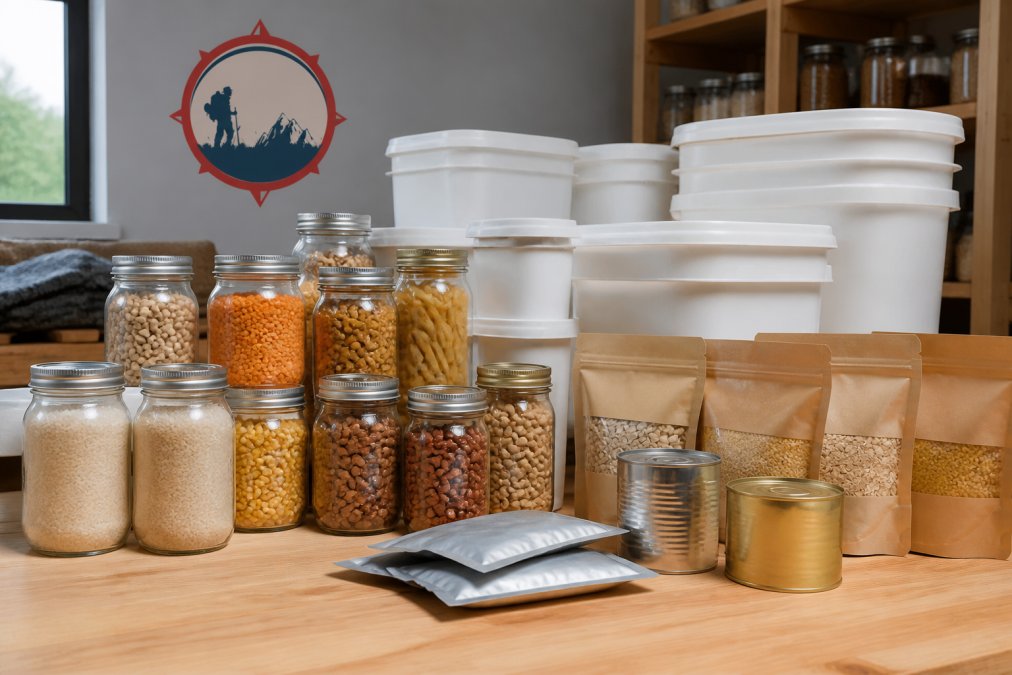
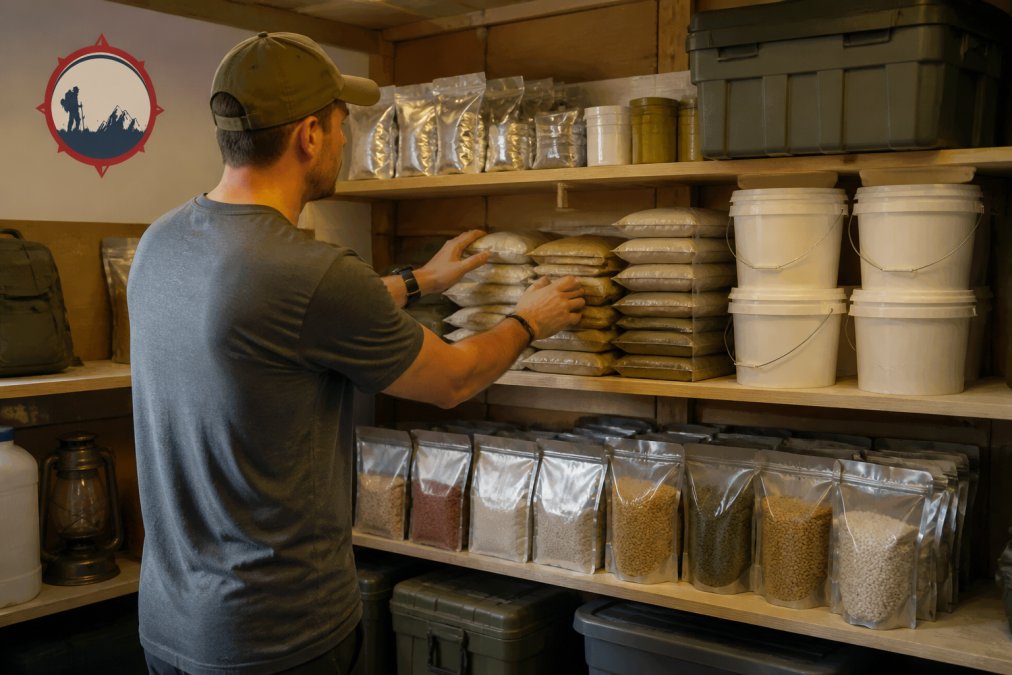
Mylar bags paired with oxygen absorbers are the workhorse of home storage. The bag blocks light and moisture; the absorber strips oxygen so nothing oxidizes or spoils. Food-grade containers, usually food-grade buckets with airtight lids, protect the bags from punctures and pests.
A few mechanics worth knowing:
- Mylar thickness is measured in mils. Thicker bags (often 5 mil and up) resist punctures better than thin 3 mil bags, which matters if you're stacking buckets or moving them around.
- Oxygen absorbers come rated in cc, for example, a 300 cc absorber suits a small jar, while a 2,000 cc absorber suits a 5-6 gallon bucket of dry grain. Match the absorber to the container volume, not the food weight.
- Heat-sealing a mylar bag with a flat iron or impulse sealer creates an airtight seam. A zip-top alone is not a long-term seal.
- Label every container with contents and the date sealed. Rotation only works if you can read the label at a glance.
A Simple Storage Audit
Before you buy another bucket, walk your storage space and check four things:
- Temperature stability. Is it steady, or does it swing with the seasons?
- Humidity. Is there any sign of condensation, rust on cans, or musty smell?
- Light exposure. Are containers in direct sun or under a bare bulb?
- Pest access. Are there gaps, cardboard boxes, or open bags that invite rodents and insects?
Emergency Food Calorie Requirements: How Much Do You Really Need?
Emergency food calorie requirements start with a simple baseline: most adults need roughly 2,000 calories per day for normal activity. In a disaster or power outage, you may burn more through stress and manual work, so plan for a buffer.
Here's how to size it:
- Adults: about 2,000 calories per day each
- Children: about 1,200-1,800 calories per day, depending on age
- Add 10-20% if you expect heavy activity or cold conditions
Freeze-Dried vs. Dehydrated: Which Belongs in Your Kits?
Freeze-dried food preserves more of its original texture, flavor, and nutrient profile than dehydrated food. That's why most premium kits use it. Dehydrated food is lighter on the wallet and works well for staples like fruits, vegetables, and jerky.
The trade-off is real:
| Factor | Freeze-Dried | Dehydrated |
|---|---|---|
| Texture after rehydration | Closer to fresh | Chewier, denser |
| Weight | Very light | Light |
| Nutrient retention | Higher | Moderate |
| Cost | Higher | Lower |
| Best for | Full meals, meat | Fruits, veggies, staples |
Cost-Per-Calorie: The Number That Exposes Overpriced Kits
Cost-per-calorie is the single best way to compare kits, and almost nobody publishes it. Divide a kit's price by its total calories. The lower the number, the better the value.
Do the math before you buy:
- Find total calories on the label.
- Divide price by total calories.
- Compare that figure across kits, not the sticker price.
- Weight the result against variety and packaging quality.
DIY vs. Commercial Kits: Where Your Money Goes Further
DIY storage usually wins on cost-per-calorie, while commercial kits win on convenience and variety. That's the honest split, but the gap is wider than most buyers realize, and it's worth running the numbers before you commit.
The DIY Math
Building your own supply means buying staple foods in bulk (rice, beans, oats, pasta), then sealing them in mylar bags with oxygen absorbers. You control quality and quantity. The catch: it takes time, research, and a steady hand with a heat sealer.
- White rice typically runs well under $1 per pound in 25- or 50-pound bags, and delivers roughly 1,600 calories per pound. That works out to a fraction of a cent per calorie.
- Dry beans are similar, often under $1.50 per pound in bulk, with about 1,500 calories per pound.
- Rolled oats are among the cheapest calories available, frequently under $1 per pound with roughly 1,700 calories per pound.
- Mylar bags and oxygen absorbers add a modest per-bucket cost, often a few dollars per 5-gallon setup, which is small relative to the food value it protects.
The Commercial Math
Commercial kits arrive ready to store. You pay for the packaging, the variety, and someone else's labor. For busy households, that premium is often worth it, but it's a premium, not a bargain.
- Variety. Multiple entrées instead of rice and beans on repeat.
- Convenience. No sealing, labeling, or sourcing.
- Portability. Pouches travel better than buckets in a go-bag.
- Predictable portions. Pre-measured meals reduce guesswork.
A Practical Middle Path
A common pattern that balances both:
- Buy a commercial kit for the first 30 days. Immediate coverage, no prep time, and you learn what your household actually eats.
- Layer in DIY bulk staples for the long tail. Rice, beans, oats, and pasta sealed in mylar extend your supply at the lowest cost per calorie.
- Add variety items last. Freeze-dried meats, sauces, and desserts fill the gaps without dominating the budget.
Our food storage selection includes gear built for both wilderness trips and home emergency pantries.
Allergen and Dietary Needs in Long Term Food Storage Kits
Standard kits are built for the average eater, which is a problem if anyone in your household has allergies or dietary restrictions. This is where most bucket marketing falls apart.
Common problem areas:
- Gluten and wheat in pasta, crackers, and many entrées
- Dairy in creamy soups and powdered drinks
- Nuts and soy hidden in protein blends
- High sodium in many ready-made meals
Frequently Asked Questions
What is the best food to stockpile long-term?
Staple foods with low moisture and high caloric density work best: white rice, rolled oats, dry beans, pasta, and freeze-dried meals. These items store for 10 to 25 years when kept in food-grade containers with oxygen absorbers. For balanced nutrition, add canned meats, peanut butter, and multivitamins. Avoid foods with high oil content, which turn rancid faster. A mix of grains, legumes, and freeze-dried proteins gives you variety and a complete macro-nutrient profile without overspending.
How many calories per day should I plan for in an emergency kit?
Most emergency preparedness guidelines suggest 1,200 to 1,500 calories per person per day for sedentary survival situations, and 2,000 to 2,500 calories for active adults or cold climates. When calculating emergency food calorie requirements for a family of four over two weeks, you need roughly 84,000 to 140,000 total calories. Check kit labels for total calories, not just servings, because serving sizes vary widely between brands.
How can I store emergency food affordably at home?
You do not need a dedicated bunker. Keep food in a cool, dark closet or under a bed, away from heat and moisture. Use food-grade containers, mylar bags, and oxygen absorbers to extend shelf life. Buy staples in bulk when they go on sale and repackage them yourself. Rotate your stock by using and replacing the oldest items first. This food rotation method keeps your emergency pantry fresh without a large upfront cost.
What is the shelf life of freeze-dried versus dehydrated food?
Freeze-dried food typically lasts 20 to 25 years when sealed properly, while dehydrated food lasts 5 to 15 years depending on moisture content and storage conditions. Freeze-drying removes about 98% of moisture, preserving texture and nutrients better. Dehydrated foods are often cheaper and work well for fruits, vegetables, and jerky. For long-term kits, freeze-dried meals offer the longest shelf life, but a combination of both can balance cost and durability.
Emergency food planning gets overwhelming fast, and the wrong kit wastes both money and shelf space. Survive Nation makes it simpler with a fast, user-friendly shopping experience, a customer-service team that answers real questions, and years of industry experience behind every recommendation. Our affordable food storage and outdoor gear are built to keep households and backpackers ready for whatever comes. Get started with Survive Nation and build a supply that actually lasts.