 how-to
How to Create an Emergency Communication Plan
Last Updated: October 24, 2026
Quick Summary
An emergency communication plan is a written set of contacts, meeting places, and backup methods your household uses to reach each other when normal phone service fails. Build one by gathering contacts for everyone in your household, choosing an out-of-area contact, setting two meeting places, and writing a fallback sequence that starts with texting. Test the plan with a drill twice a year and update it every six months.
- Keep your contact list to one page and print two copies, one for the fridge and one for each go-bag.
- Pick an out-of-area contact in another region, since local lines jam first during a disaster.
- Choose two meeting places, one right outside your home and one outside your neighborhood.
- Text first during an outage, keep messages short, and avoid group threads in the first hour.
- Run a drill twice a year and update numbers every six months and after any life change.
Table of Contents
- Step 1: Gather Contact Information for Everyone in Your Household
- Step 2: Build Your Emergency Contact List Template
- Step 3: Choose an Out-of-Area Emergency Contact
- Step 4: Set Meeting Places and Evacuation Routes
- Step 5: Plan How You'll Receive Alerts and Communicate During an Outage
- Emergency Communication Plan Examples for Households, Schools, and Workplaces
- Your Emergency Communication Plan Checklist: Test, Share, and Update
- Stock the Gear That Keeps Your Plan Working
- Frequently Asked Questions
Step 1: Gather Contact Information for Everyone in Your Household
An emergency communication plan is a written set of contacts, meeting places, and backup methods your household uses to reach each other when normal phone service fails.
So start here. Sit down with every person in the house and collect:
- Full names and mobile numbers for each household member
- Work, school, and daycare phone numbers
- Two neighbors' names and numbers
Write down what each person needs, too. Note medications, mobility needs, and pets. That detail matters when someone else has to help.
Keep this list short. One page beats five. The Ready.gov family emergency communication plan guidance makes the same point: a plan you can actually use beats a thick binder nobody opens.
Step 2: Build Your Emergency Contact List Template
A good emergency contact list template fits on one page and works when the power is out. Paper beats apps here. Phones die. Batteries run out.
Here's a template you can copy by hand right now:
| Field | What to Write |
|---|---|
| Household member | Name, mobile, work or school number |
| Out-of-area contact | Name, number, city |
| Local backup | Neighbor or relative, name and number |
| Meeting places | Two addresses, one near, one far |
| Medical notes | Allergies, medications, conditions |
| Utility contacts | Power, water, gas company numbers |
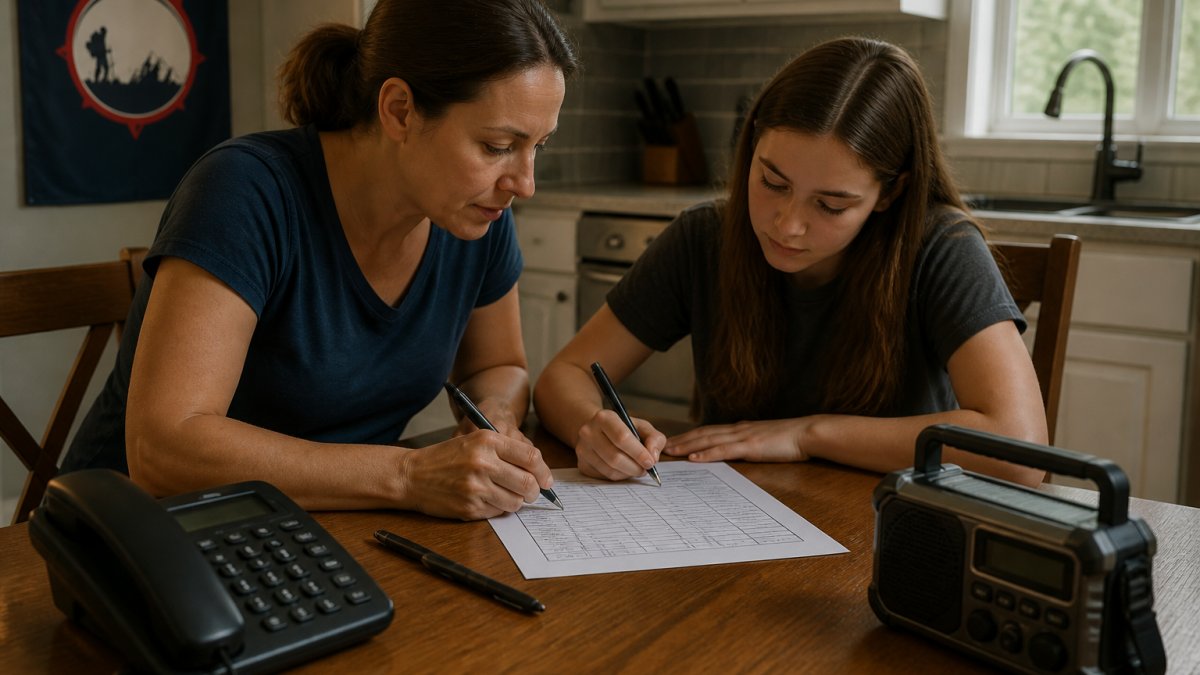
Print two copies. Put one on the fridge and one in each go-bag. Laminate them if you can. A wet, smudged list is useless.
What to Put on Each Contact Card
Every person in the house should carry a small card with the same core facts. Think of it as a mini version of your list.
Each card needs:
- The person's name and date of birth
- Two emergency contacts with numbers
- The out-of-area contact
Kids can keep one in a backpack. Adults can keep one in a wallet. This is the part most guides skip, and it's the part that matters when someone is separated from the group.
Step 3: Choose an Out-of-Area Emergency Contact
An out-of-area emergency contact is someone who lives far enough away that a local disaster won't affect them.
Why someone far away? Because local lines jam first. When a storm or fire hits, calls inside the affected area often fail.
Here's how to set it up:
- Ask the person first. Don't assume they'll play this role.
- Give them a copy of your household list.
- Teach every family member to call or text them if separated.
- Have that contact relay messages between family members.
One rule that saves confusion: if you can't reach each other, check in with the out-of-area contact. Everyone reports to the same person.
Step 4: Set Meeting Places and Evacuation Routes
Two meeting places cover most situations: one right outside your home, and one outside your neighborhood. The first handles a house fire. The second handles an evacuation order.
Pick them now, while things are calm. Then walk the routes with everyone in the house.
- Nearby spot: the big tree at the end of the driveway, the mailbox, or a neighbor's front steps
- Neighborhood spot: a library, school, or community center everyone can walk to
- Far spot: a relative's home or a landmark outside the evacuation zone
Map at least two ways out of your neighborhood. Roads close. Bridges shut down. Having a backup route keeps you moving.
Picking a Neighborhood Meeting Place
Choose a spot that's easy to find in the dark and reachable on foot. A well-lit library or school parking lot works well. Avoid spots that flood or sit near busy highways.
Test it. Walk there together on a normal day. Time it. Kids should be able to get there without a phone.
Step 5: Plan How You'll Receive Alerts and Communicate During an Outage
When cell networks fail, you need a backup communication method ready before the outage. Most guides stop at "get a radio and text instead of calling." That advice is correct but incomplete. What actually determines whether your household connects during a real outage is the order in which you try each channel, and what you do when the first two fail.
Build a fallback sequence everyone memorizes. The sequence below is a common pattern among preparedness practitioners; adapt the order to your household.
Channel-by-Channel Fallback Sequence
1. Text first, and keep it short. Texts often slip through when calls don't because they use less network capacity and can queue for delivery.
2. Try the out-of-area contact. If local texts fail, long-distance calls and texts often still route because they leave the affected network.
**3.
**4.
5. Fall back to radio and physical check-ins. A battery-powered or hand-crank NOAA weather radio receives official alerts when nothing else does.
Match the Plan to the Failure
Different failures knock out different channels, so the plan should say what to do for each:
- Power outage only: phones still work until batteries die. Conserve battery, keep phones above half charge, and use the radio for alerts.
- Cellular network overloaded: texts and the out-of-area contact are your best bets; skip calls and group threads.
- Internet loss: Wi-Fi messaging is out; rely on cellular, landline, and radio.
Gear That Backs the Sequence
For alerts, a NOAA weather radio is the tool that keeps working when cell towers don't. If you're shopping for one, a multi-powered emergency radio with NOAA runs on hand crank, solar, and battery power. A hand-crank USB phone charger keeps phones alive long enough to send that check-in text. Keep a written copy of the fallback sequence with the radio so the plan and the gear live in the same place.
Emergency Communication Plan Examples for Households, Schools, and Workplaces
The same framework scales across settings. A household plan, a school plan, and a workplace plan all rest on the same parts: contacts, meeting places, and a check-in method.
Here's how each looks in practice:
- Household: a one-page contact list on the fridge, two meeting places, one out-of-area contact, and a check-in text rule
- School: a contact card in each child's backpack, a pickup plan, and a reunification spot at the front office
- Workplace: a communications team with named roles, a group contact list, and a shelter and evacuation plan posted on each floor
For schools and workplaces, name a backup for every role. If the person who holds the list is out, someone else needs it. Keep a first aid kit suited to the setting too.
Your Emergency Communication Plan Checklist: Test, Share, and Update
A plan you never test is just paper. The difference between a plan that works and one that fails is a simple drill, a review schedule, and update triggers tied to real life events. This section gives you all three, plus a filled-in example you can copy.
Run a Simple Drill Twice a Year
A drill doesn't need to be elaborate. Set a date, then run this sequence:
- At a set time, every household member texts the out-of-area contact: "Drill. Safe at [location]."
- The out-of-area contact confirms each message arrived and replies with a single confirmation.
- One person checks the NOAA radio and reads back the current alert or test message.
- Everyone walks to the nearby meeting place and times it.
- Note what failed: a wrong number, a dead battery, a child who didn't know the route.
Fix what failed before the next drill. Most practitioners find two drills a year, spaced about six months apart, catch stale numbers and dead batteries before a real event does.
Review Cadence and Update Triggers
Put a recurring reminder on the calendar, and also update the plan whenever one of these happens:
- A phone number, job, school, or daycare changes
- Someone moves in or out of the household
- A child gets a first phone or starts walking to school alone
Filled-In Example
Here is what a completed one-page plan looks like for a household of four:
| Field | Example Entry |
|---|---|
| Household members | A. Rivera, mobile; J. Rivera, mobile; two children, school and daycare numbers |
| Out-of-area contact | M. Chen, aunt, out of state, number memorized by all |
| Local backup | Neighbor across the street, name and mobile |
| Nearby meeting place | Mailbox at end of driveway |
| Neighborhood meeting place | Public library parking lot, 0.4 miles, walkable |
| Far meeting place | Relative's home outside the evacuation zone |
| Medical notes | Child 1: peanut allergy, epinephrine in go-bag; Child 2: asthma inhaler |
| Utility contacts | Power, water, and gas company numbers |
| Check-in rule | Text out-of-area contact; if no reply in 30 minutes, call |
Checklist
- Contact list printed and posted in two places
- Contact card in every backpack and wallet
- Out-of-area contact confirmed and briefed
Share the plan with a trusted neighbor and your out-of-area contact. Then set the reminder. Jobs change. Numbers change. Kids grow up.
Stock the Gear That Keeps Your Plan Working
The best plan still needs gear behind it. A radio with dead batteries, a phone at zero percent, and a missing first aid kit turn a solid plan into a scramble.
Start with the basics. A home emergency kit checklist shows what to stock so your plan works when you need it. An emergency power outage supply list covers the outage scenario most households face first.
At Survive Nation, we stock the gear that backs up the plan: lighting, power backups, food storage, and first aid, all at affordable prices to ensure accessibility for every adventurer.
Frequently Asked Questions
What should an emergency communication plan include?
A complete emergency communication plan includes contact information for every household member, an out-of-area emergency contact, at least two meeting places, evacuation routes, and a backup communication method for network outages. Add a printed copy of your contact list to every go-bag and your vehicle. The plan should also name who checks on children, older relatives, and pets, and set a schedule for testing and updating it.
How do you create a family emergency communication plan?
Start by gathering phone numbers and email addresses for each family member, then build an emergency contact list template with a paper copy for every bag. Choose an out-of-area emergency contact everyone can call or text, since local lines often jam first. Agree on a neighborhood meeting place and one outside your area, map two evacuation routes, and practice the plan twice a year so everyone knows their role.
What should you do if phone service is unavailable during an emergency?
Text instead of calling, since text messages often get through when voice networks are congested. If texts fail, try a backup communication method: a battery-powered or hand-crank radio for alerts, a satellite messenger, or a prearranged check-in time at a neighbor's house. Keep a printed copy of your emergency contact list so you never depend on a phone that has lost power or signal.
How often should you update an emergency communication plan?
Review your plan every six months and after any major change, such as a move, a new phone number, a new school, or a change in caregivers. Replace expired batteries and food in your kit at the same time. Run a practice drill with your household at least once a year, then note what was confusing and fix it. An outdated contact list is one of the most common reasons a plan fails.
Most households have a plan in their heads and nothing on paper. That's the gap a real emergency communication plan closes. Get the contacts down, pick your meeting places, and test it once. Survive Nation makes the gear side easy with fast online shopping and a customer service team that answers questions before you buy. Get started with Survive Nation and build a kit that's ready before the lights go out.