 ultimate-guide
Sleeping Bag Temperature Ratings Explained for Campers
Last Updated: November 5, 2026
Quick Summary
Sleeping bag temperature ratings are tested estimates of the lowest temperature at which a bag should keep an average sleeper warm, not a promise of comfort at that number. Labels usually show a comfort rating for cold sleepers, a lower-limit rating for an average man, and an extreme survival figure you should never treat as your buying target.
- Build your purchase around the comfort rating, which reflects the coldest conditions a cold sleeper can handle.
- The 3-season range generally runs from a comfort rating near 30 degrees Fahrenheit down to roughly 15 to 20 degrees.
- Subtract 10 degrees from the forecast low as a safety margin, and another 5 if you sleep cold.
- Pair a three-season bag with a pad rated around R-3 to R-4, and R-5 or above for winter.
- Compare comfort to comfort and limit to limit, and never match one bag's comfort rating against another's extreme rating.
Table of Contents
- What Sleeping Bag Temperature Ratings Actually Mean
- The Sleeping Bag Comfort Rating and Who It Is Built For
- 3-Season Sleeping Bag Temperature Range and When to Size Up
- 20-Degree vs. 0-Degree Sleeping Bag: Picking Your Cold-Weather Limit
- Backpacking Sleeping Bag Temperature Ratings and the Full Sleep System
- Why a Rating Is a Guide, Not a Guarantee
- Reading Labels Across Regions and Older Bags
- Choosing Your Sleeping Bag at Survive Nation
- Frequently Asked Questions
What Sleeping Bag Temperature Ratings Actually Mean
Sleeping bag temperature ratings explained simply: a rating is a tested estimate of the lowest temperature at which a bag should keep an average sleeper warm, not a promise that you will be comfortable at that number. The confusion is understandable. A bag labeled "20 degrees" can leave one camper shivering at 35 degrees and another sleeping soundly at 25. The rating describes a test result, not your night.
Three numbers usually appear on the label, and they mean different things.
Comfort, Lower-Limit, and Extreme Ratings
Comfort rating is the temperature at which a cold-sensitive sleeper, typically a woman, can sleep in a relaxed posture without feeling cold. Lower-limit rating is the temperature at which an average man in a curled posture stays warm through the night. Extreme rating is a survival figure: it describes staying alive, not sleeping well, and it should never be your buying target.
A common mistake is treating the extreme rating as the usable limit. It is not. Treat it as the number you hope never to test.
How Standardized Testing Works
Standardized testing uses a heated mannequin wearing a base layer, measured inside a climate chamber under controlled conditions. The ISO 23537 sleeping bag standards overview defines how manufacturers run these tests and report results, which is why two bags from different brands can be compared at all. The test assumes a dry bag, still air, and a sleeping pad underneath. Change any of those and the number stops matching your night.
The Sleeping Bag Comfort Rating and Who It Is Built For
The sleeping bag comfort rating is the number to build your purchase around, because it reflects the coldest conditions a cold sleeper can handle without waking up chilled. If you sleep cold, plan around comfort. If you sleep warm, the lower limit is a reasonable guide.
Gender labeling matters here. Women's bags are typically cut shorter and filled with more insulation in the footbox and torso, and their ratings reflect a colder-sleeping test subject. A unisex bag rated to the same lower limit often feels colder to a woman of similar size.
3-Season Sleeping Bag Temperature Range and When to Size Up
The 3-season sleeping bag temperature range generally runs from a comfort rating near 30 degrees Fahrenheit down to roughly 15 to 20 degrees, covering spring through fall camping in most conditions. That range handles frosty mornings and cool mountain nights without the bulk of a winter bag.
Size up when the forecast low sits within about 10 degrees of your bag's comfort rating. Ratings assume ideal conditions, and a wet, windy night at altitude is not ideal. If you expect repeated nights below freezing, move to a winter-rated bag rather than layering your way through it. You can browse a Kamperbox 3 season sleeping bag as a concrete example of what that range looks like in practice.
20-Degree vs. 0-Degree Sleeping Bag: Picking Your Cold-Weather Limit
The 20-degree vs. 0-degree sleeping bag decision comes down to your coldest expected nighttime low, minus a safety margin. A 20-degree bag suits late spring through early fall and mild winter trips.
Here is the method we recommend:
- Find the forecast nighttime low for your trip.
- Subtract 10 degrees as a safety margin for wind, humidity, and wet gear.
- Match that number to the bag's comfort rating, not its extreme rating.
- If you sleep cold, subtract another 5 degrees.
Worked example: a forecast low of 30 degrees minus 10 gives 20 degrees, so a 20-degree comfort-rated bag fits an average sleeper. A cold sleeper should step down to a 15-degree bag. For colder trips, view a Kamperbox winter warm sleeping bag to see how a 0-degree option compares.
Backpacking Sleeping Bag Temperature Ratings and the Full Sleep System
Backpacking sleeping bag temperature ratings only hold up when the rest of your sleep system supports them. The bag is one layer. The pad beneath it, the clothes you wear, and the liner you add all change how warm you actually sleep.
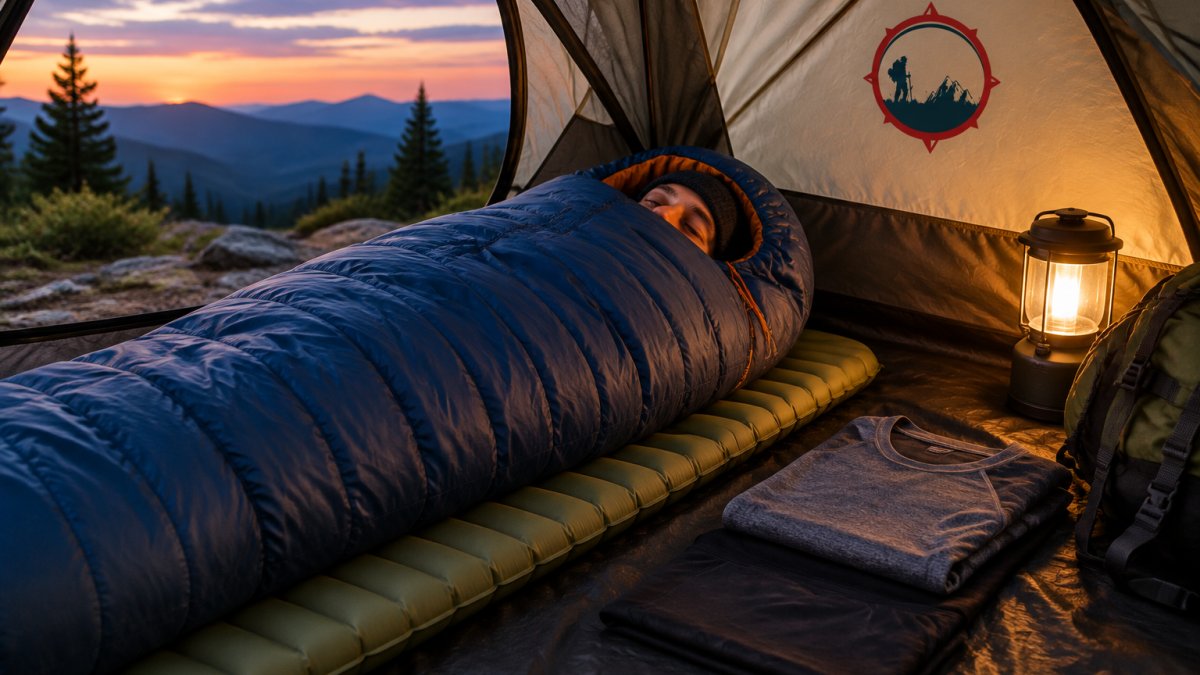
Pad R-Value, Layering, and What Your Bag Does Not Cover
Insulation under your body compresses flat, so a bag provides almost no warmth beneath you. That job belongs to the pad. R-value measures a pad's resistance to heat loss, and a higher R-value means a warmer night.
Layer deliberately. A dry base layer, a hat, and a liner add meaningful warmth without a new bag. Skip cotton, which holds moisture and pulls heat away from your body. If you are building out your kit, you can shop lightweight sleeping pads to match your bag's rating.
Why a Rating Is a Guide, Not a Guarantee
A rating is a guide because the test chamber is not your campsite. Wind strips warmth from a bag's shell, humidity reduces loft, and a bag that has been stored compressed for years loses insulation performance. Your metabolism, hydration, and what you ate before bed all shift how warm you sleep.
Watch out: a wet bag can lose much of its insulating value, and down is especially vulnerable. Keep your bag dry, air it out each morning, and store it loose rather than stuffed. Our guide on why sleeping bags lose warmth covers storage and care in detail.
Reading Labels Across Regions and Older Bags
Labels are not uniform. Some bags carry EN ratings, some carry ISO 23537 ratings, and older or budget bags may show only a single temperature with no test standard behind it. A single number with no comfort, limit, or extreme breakdown tells you very little.
Treat unlabeled bags with caution. Without a stated standard, the number is a marketing figure, not a tested result. When comparing bags, compare comfort to comfort and limit to limit, and never compare a comfort rating on one bag to an extreme rating on another. That mismatch is the most common reading error we see.
A Practical Method for Mixed Labels
When you are comparing bags from different brands or eras, follow a fixed order so you do not compare unlike numbers:
- Look for a standard citation first, ISO 23537 or EN 13537. If it is present, the bag reports comfort, lower limit, and extreme, and you can compare it to other tested bags.
- If no standard is cited, look for a comfort value. If the label shows only one number, assume it is closer to a lower limit than a comfort rating, and add margin.
- If the label shows a range with no breakdown, treat the warm end as a rough comfort figure and the cold end as a survival figure, not a sleeping temperature.
- If the label shows only an extreme or survival number, do not plan a trip around it. That figure describes staying alive, not sleeping well.
- When in doubt, size down, choose a bag rated colder than your forecast low rather than trusting an ambiguous label.
Manufacturer-Specific and Legacy Labels
Some brands publish their own temperature scales, and some older bags predate the EN and ISO standards entirely. A manufacturer-specific label may be honest and well-tested, but it is not directly comparable to a standardized rating unless the brand states which standard it follows.
Watch out: a legacy bag with a single temperature and no standard is the hardest label to trust. If you cannot confirm the test standard or the bag's storage history, treat its rating as a rough guide and plan a safety margin.
| Rating Type | What It Measures | Who It Fits | Use It For |
|---|---|---|---|
| Comfort | Cold sleeper, relaxed posture | Women, cold sleepers | Your primary buying target |
| Lower limit | Average sleeper, curled posture | Men, warm sleepers | A secondary check |
| Extreme | Survival, not comfort | No one, ideally | Awareness only |
| Unlabeled | Untested marketing figure | Unknown | Avoid for cold trips |
| Manufacturer-specific | Brand's own scale | Varies | Compare only within that brand |
| Legacy (pre-standard) | Older test or estimate | Varies | Add margin; verify storage history |
Choosing Your Sleeping Bag at Survive Nation
Choosing the right bag starts with one honest question: how cold will it actually get, and how cold do you sleep? Answer that, apply the 10-degree safety margin, and match the result to a comfort rating. Everything else, from fill type to shell fabric, is secondary to getting the temperature range right.
At Survive Nation, we stock sleeping bags for weekend campers and preparedness kits alike, backed by a fast, user-friendly shopping experience. Browse our full selection of sleeping bags to find a bag that matches your rating.
Frequently Asked Questions
What temperature rating sleeping bag should I get?
Start with the lowest nighttime temperature you expect, then add a safety margin of about 10 degrees Fahrenheit. For typical three-season camping where lows sit near 40°F, a bag with a comfort rating around 30°F works well. If you sleep cold or camp in spring and fall, move down to a 20°F bag. Match the bag's comfort rating, not its extreme rating, to your expected low.
What is the difference between a sleeping bag's comfort and limit ratings?
The comfort rating is the temperature at which an average woman in a base layer and socks sleeps without waking from cold. The lower limit is where an average man stays warm in a curled position. The extreme rating is a survival figure only, not a sleeping temperature. For most campers, the comfort rating is the number to plan around, especially if you tend to sleep cold.
Is a 20-degree sleeping bag too hot for summer?
It can be. A 20°F bag is built for nights near freezing, so on a 60°F summer night you will likely unzip it and use it as a quilt. That works, but a lighter 30°F to 40°F bag vents better and packs smaller. If you only own one bag and camp across seasons, a 20°F bag with a full-length zipper gives you the most flexibility.
How accurate are sleeping bag temperature ratings?
Ratings from ISO 23537 testing are consistent between brands, but they assume a dry bag, a warm pad, a base layer, and a sheltered tent. Wind, humidity, wet insulation, and a thin pad all push your real comfort colder than the label. Treat the rating as a starting point and add roughly 10°F of margin for real campsite conditions.
How do sleeping pad and clothing choices affect sleeping bag warmth?
Your bag insulates from above; your pad insulates from below. A pad with an R-value of 4 or higher is a reasonable match for a 20°F bag, while a thin foam pad leaves you cold no matter how good the bag is. Add a dry base layer, a hat, and a liner to extend a bag's range by several degrees without buying new gear.
Which is better for me, a 20-degree or a 0-degree sleeping bag?
A 20°F bag suits three-season camping and most backpacking trips where lows stay above 20°F. A 0°F bag is for winter camping and high-altitude trips, and it costs more, weighs more, and packs larger. If you camp mostly in summer and fall, the 20°F bag is the better buy. Choose the 0°F bag only if you expect sustained sub-freezing nights.
The gap between a good night's sleep and a miserable one usually comes down to one number on a label, read correctly. If you are ready to match a bag to your conditions, get started with Survive Nation and build a sleep system that keeps you warm when the temperature drops.