 How-to
Does a Sleeping Pad Provide Insulation?
Last Updated: November 24, 2026
Quick Summary
Yes, does a sleeping pad provide insulation, but only if it is built to trap heat. A plain air pad is mostly a cushion with little warmth, while a foam-filled or reflective pad slows heat loss to the ground. The pad under you matters as much as the bag over you.
- A pad slows conductive heat loss to the ground rather than creating warmth.
- R-value measures thermal resistance, and a higher number means more warmth.
- Cold sleepers should add roughly one R-value point to the chart's suggestion.
- Squeeze the pad: foam or a crinkly reflective sheet means it is insulated.
- Layer a closed-cell foam pad under an inflatable pad to add roughly its rating.
Table of Contents
- Does a Sleeping Pad Provide Insulation? The Short Answer
- How Sleeping Pads Trap Heat and Stop Ground Heat Loss
- Sleeping Pad R-Value Chart: Reading Thermal Resistance
- Insulated vs. Non-Insulated Sleeping Pad: What Actually Changes
- Matching Pad Warmth to Temperature and Season
- How to Add R-Value to a Sleeping Pad
- Foam vs. Air vs. Self-Inflating: Pad Type Comparison
- When a Pad Leaks or Deflates Overnight
- Frequently Asked Questions
Does a Sleeping Pad Provide Insulation? The Short Answer
Not every sleeping pad provides insulation. A plain air pad is mostly a cushion with little warmth, while a foam-filled or reflective pad slows heat loss to the ground. The pad under you matters as much as the bag over you. So does a sleeping pad provide insulation? Yes, if it is built to trap heat. A basic air mattress is not.
Here is the part most guides skip. The ground steals body heat through direct contact, a process called conduction. A pad slows that transfer. How well it does depends on its materials, its thickness, and a number you will see on the label: R-value.
Below, we break down exactly how pads hold warmth, how to read that number, and how to pick the right one for summer nights or winter trips.
How Sleeping Pads Trap Heat and Stop Ground Heat Loss
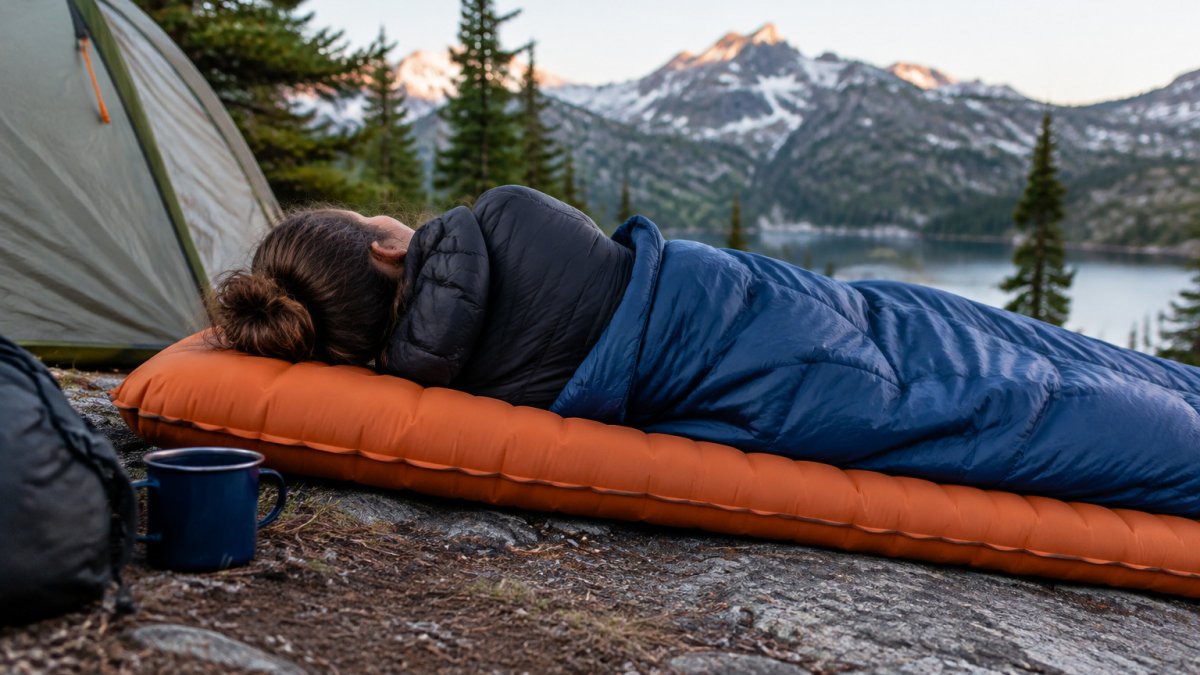
A sleeping pad works like a thin wall between your body and the cold earth. It does not create heat. It slows the rate at which your warmth drains away. That is the whole job, and it is why pad choice changes how you sleep.
Conduction: Why the Ground Pulls Heat Out of You
Conduction is heat moving from a warm object to a cold one that touches it. Lie on bare ground and your body heat flows straight into the soil. The colder the ground, the faster that drain. A pad interrupts this path.
Foam Cores, Air Chambers, and Reflective Layers
Three designs do the work:
- Foam cores trap tiny air pockets that resist heat flow.
- Air chambers slow conduction but can move warm air around inside.
- Reflective layers bounce body heat back toward you.
Sleeping Pad R-Value Chart: Reading Thermal Resistance
R-value measures thermal resistance, or how well a pad blocks heat loss. A higher number means more warmth. R-value is tested under a standardized method, so ratings from different brands are at least nominally comparable, though real-world warmth still varies with the sleeper and conditions.
This sleeping pad R-value chart shows what each range is generally good for:
| R-Value | Warmth Level | Typical Use |
|---|---|---|
| 1-2 | Minimal | Warm summer nights, ground above 60°F |
| 2-3.9 | Moderate | Three-season camping, overnight lows in the 40s and 50s |
| 4-5.9 | High | Cold spring and fall, overnight lows near or below freezing |
| 6+ | Maximum | Winter and snow, sub-freezing nights and frozen ground |
Read the label before you buy. A thicker pad is not always a warmer one. Warmth comes from what is inside, not just how tall it sits.
Putting R-Value Into Practice
The chart is a starting point, not a guarantee. A few practical rules help translate the number into a real night's sleep:
- Cold sleepers need more. If you tend to feel cold at 50°F in a normal bed, add roughly one R-value point to whatever the chart suggests.
- Ground temperature matters as much as air temperature. Sleeping on snow, rock, or concrete pulls heat faster than soil or forest duff, so bump up a band when the surface is frozen or exposed.
- The pad is one part of a system. A high-R pad under a bag rated for warmer temperatures still leaves you cold. Match the pad to the bag and to the clothing you wear to bed.
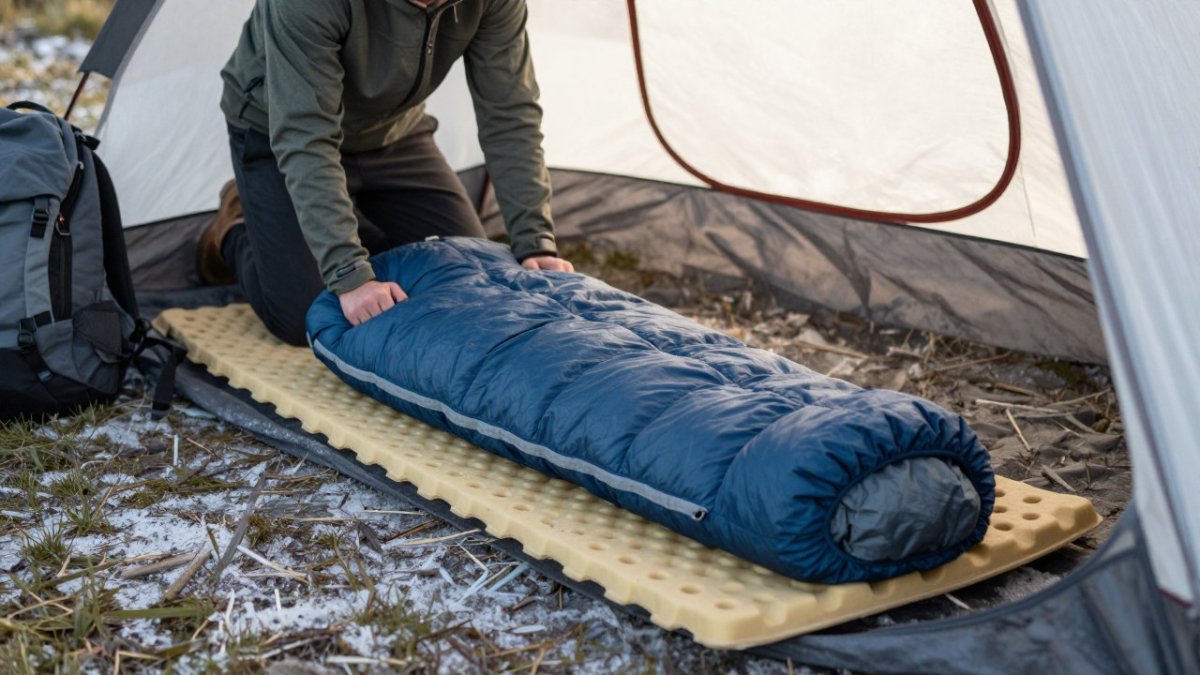
- R-value stacks when you layer pads. A closed-cell foam pad (often around R-2) under an inflatable pad adds roughly its rating to the total, which is why layering is the cheapest way to extend a three-season pad into winter.
Watch out: R-value is tested in a lab with a standardized hot plate, not with a moving, sweating human, so treat the label as a comparison tool between pads rather than a promise of comfort at a specific temperature.
Insulated vs. Non-Insulated Sleeping Pad: What Actually Changes
An insulated pad adds foam, reflective film, or trapped air pockets to slow heat loss. A non-insulated pad is mostly a cushion. The gap between them shows up on cold nights, not warm ones.
A simple test tells you which one you own. Squeeze the pad. If you feel foam or hear a crinkly reflective sheet, it is insulated. If it is just a hollow air chamber, it is not. Many people find their "air mattress" is really a non-insulated pad, which explains a cold back on a chilly night.
Matching Pad Warmth to Temperature and Season
Match the R-value to the low temperatures you expect, not the daytime highs. A pad rated for summer will feel cold in fall. Pair your pad choice with the right sleeping bag temperature ratings explained for campers so the whole system works together.
Summer, Three-Season, and Winter Camping
- Summer: a low R-value pad is usually enough on warm ground.
- Three-season: a mid-range pad handles most spring-to-fall trips.
- Winter: choose a high R-value pad, and consider pairing it with a winter-rated bag like the Kamperbox winter warm sleeping bag.
How to Add R-Value to a Sleeping Pad
You can boost warmth without buying a new pad. The cheapest fix is layering. Put a closed-cell foam pad under your inflatable pad to block ground cold. Add a reflective layer on top or beneath to bounce heat back.
A reflective thermal blanket makes a light, packable addition. Our emergency solar thermal blanket can sit under a pad as an extra insulation layer. Also dress warm, keep your pad off bare rock, and clear sharp debris from the ground first. Small steps add up on a cold night.
Foam vs. Air vs. Self-Inflating: Pad Type Comparison
Each pad type trades warmth, comfort, weight, and durability in different ways. Here is how they stack up:
| Pad Type | Warmth | Comfort | Weight | Durability |
|---|---|---|---|---|
| Closed-cell foam | Good | Firm | Light | Very high |
| Air pad | Varies | High | Light | Lower |
| Self-inflating | Moderate | Medium | Medium | Good |
Foam pads resist leaks and can work as a backup. Air pads pack small and sleep soft but can puncture. Self-inflating pads split the difference. For a concrete option, see our 3-inch inflatable waterproof camping pad, or compare it with a self-inflating folding camp mattress if you want foam inside.
When a Pad Leaks or Deflates Overnight
A pad that goes flat overnight usually has a slow leak at a seam, valve, or puncture. The failure is rarely dramatic, most leaks lose air over hours, so you wake up on hard, cold ground rather than noticing a sudden deflation.
Finding the Leak
- Inflate the pad fully and listen along the seams and valve for a faint hiss.
- Brush soapy water along the surface, a 1:4 dish soap-to-water mix works, and watch for bubbles forming at the leak point.
- Submerge the pad in a bathtub or calm water if you have one; escaping air shows as a steady stream of bubbles.
- Mark the spot with a bit of tape or a pen so you do not lose it when the pad dries.
Field Repair
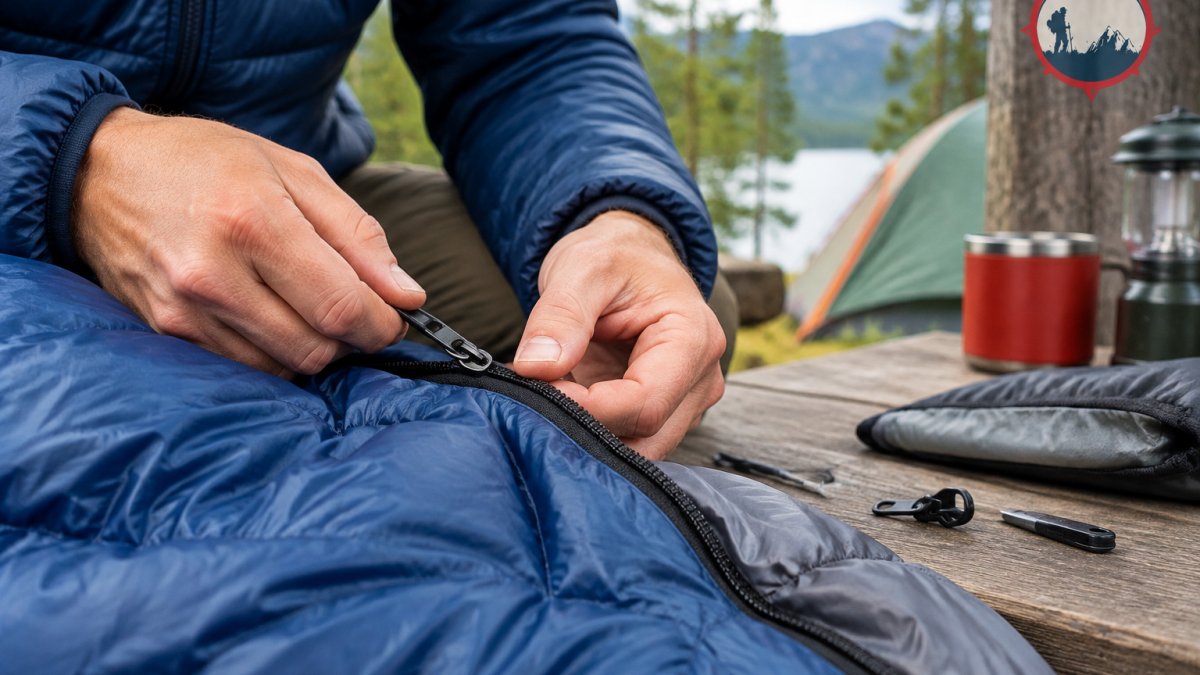
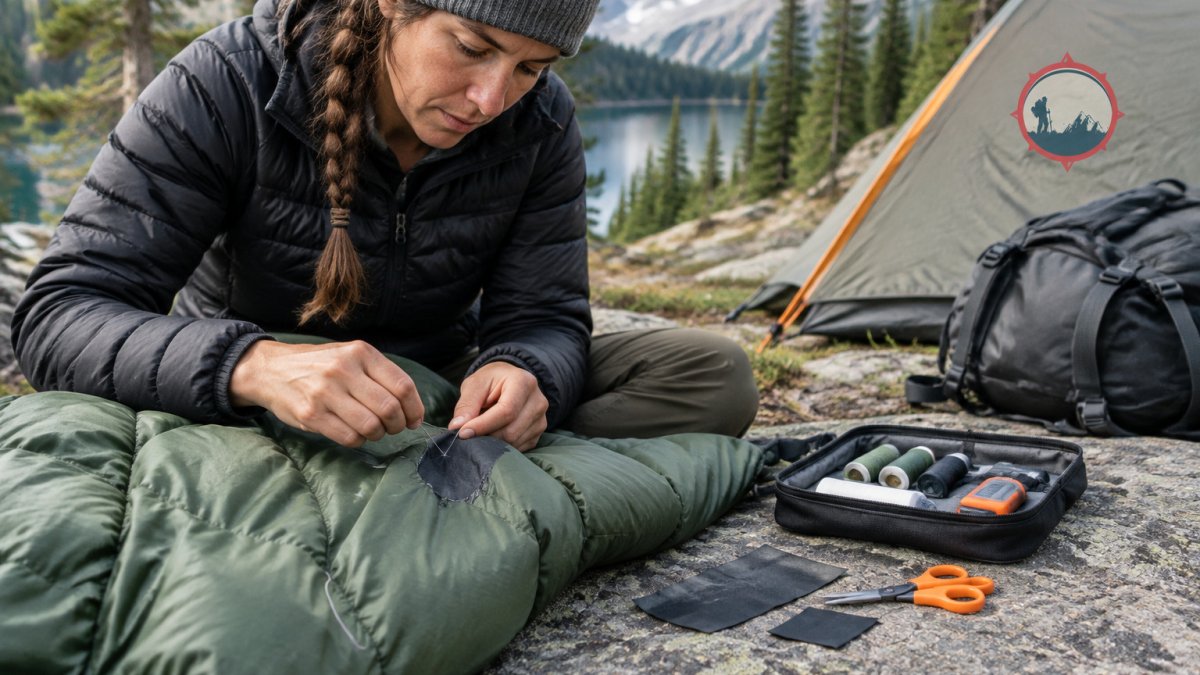
Most small holes in inflatable pads can be fixed with the patch kit that ships with the pad or a dab of urethane adhesive. Clean and dry the area first, apply the patch, and let it cure per the kit instructions, usually 15 to 30 minutes for a field repair, longer for a permanent bond. Valve leaks are harder to patch in the field; a replacement valve or a wrap of plumber's tape can sometimes get you through the night.
The Backup Plan
If a leak hits mid-trip and you cannot repair it, do not sleep on bare ground. Layer a closed-cell foam pad or a reflective blanket underneath as a backup, even a thin foam layer adds meaningful R-value and keeps your bag off the cold surface. A reflective thermal blanket can sit under the deflated pad as a stopgap.
Preventing the Next Failure
Check your pad at home before every cold-weather trip: inflate it, let it sit overnight, and see whether it holds firm by morning. Clear sharp debris, twigs, rocks, pine needles, from the tent floor before laying the pad down, and store the pad loosely rolled with the valve open so the foam and seams are not compressed between trips.
Watch out: a slow leak that only shows up in cold weather is often a valve issue rather than a puncture, because plastic valves contract and seal less tightly at low temperatures, check the valve first before hunting for holes in the pad body.
Cold ground is the fastest way to ruin a night outdoors, and the fix starts with the right pad. At Survive Nation, we stock reliable sleeping pads, bags, and thermal layers built for real trips and home emergency kits. Our fast, easy online shopping and customer-focused service make gear-up simple. Get started with Survive Nation and sleep warmer on your next trip.
Frequently Asked Questions
Does a sleeping pad provide insulation from the ground?
Yes, but only if it is designed to. Every pad slows heat transfer somewhat, yet closed-cell foam and insulated air pads do the real work. Sleeping pad insulation is measured by R-value, which rates thermal resistance. A thin uninsulated air pad offers little warmth because air moves inside it and carries your body heat to the cold ground. A pad with foam or a reflective layer traps that heat instead, keeping your underside warmer through the night.
What R-value sleeping pad do I need for 20-degree weather?
For nights around 20°F, look for an R-value of 5 or higher. A sleeping pad R-value chart typically places R-1 to R-2 in summer, R-3 to R-4 for three-season use, and R-5 and up for winter camping. Below freezing, an insulated pad with a foam core or reflective layer matters more than thickness alone. Pair it with a sleeping bag rated for the same temperature and you cover both top and bottom heat loss.
How can I add R-value to my sleeping pad?
The simplest method is layering pads. Put a closed-cell foam pad under your inflatable pad to add roughly R-1 to R-2 of ground insulation. You can also use a reflective emergency blanket between the pad and the ground, wear dry insulating layers to bed, and avoid compressing your sleeping bag against the pad. Keep in mind that stacking pads adds warmth, but only the layer closest to your body counts fully toward comfort.
Does a sleeping pad still insulate if it has a hole and deflates?
Partially. A deflating air pad loses the air gap that separates you from the cold ground, so warmth drops fast. Foam-core and self-inflating pads keep some insulation even when flat because the foam itself resists heat transfer. If your pad leaks overnight, patch it as soon as possible, add a foam pad underneath as a backup, and check the valve and seams before your next trip. Carry a repair kit on any cold-weather outing.