 blog
blog
Best Outdoor Lighting for Camping: 2026 Buyer's Guide
Table of Contents
- Best Outdoor Lighting for Camping: What Actually Matters
- Best Camping Lanterns for Every Trip Type
- Rechargeable Camping Lights: Power Without the Waste
- Camping String Lights for Ambient Campsite Glow
- Waterproof Camping Lights: What IP Ratings Actually Mean
- Lighting Plans by Campsite Layout and Trip Type
- Light Pollution, Battery Care, and Long-Term Value
- Conclusion: Building a Lighting Kit That Works
- Frequently Asked Questions
Last Updated: October 9, 2026
Best Outdoor Lighting for Camping: What Actually Matters
The best outdoor lighting for camping is not one light but a small system: a lantern for the tent, a headlamp for your hands, and something soft for the table after dark. We sell camping and emergency lighting.
Most buyers make the same mistake: one bright light expected to cover everything.
Brightness is the easiest spec to compare and the least useful on its own. A 1,000-lumen lantern that dies in three hours is worse than a 300-lumen model that runs all weekend. The U.S. Department of Energy guidance on LED lighting makes the same point in plain terms: efficiency and runtime matter as much as raw output.
Below, we break down how to evaluate lights, then match them to trip types, campsite layouts, and power plans.
How We Evaluated These Lights
Camping lights can be judged on five things, in this order:
- Runtime at usable brightness, not at the lowest dim setting
- Charging method, since USB-C has largely replaced proprietary cables
- Weather sealing, expressed as an IP rating
- Mounting options, meaning hooks, magnets, or a flat base that stands up
- Weight and packed size for anyone carrying gear on their back
A common mistake is trusting the "up to X hours" claim on the box, which usually assumes the dimmest mode. Ask what runtime looks like at medium output.
Best Camping Lanterns for Every Trip Type
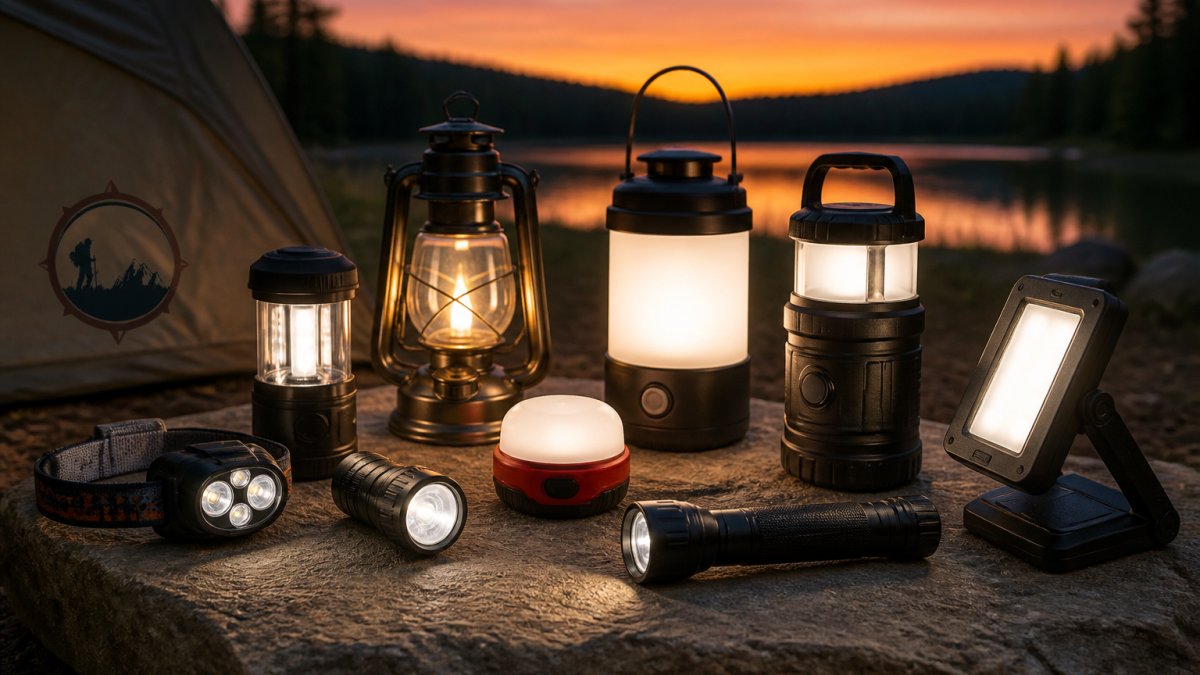
The best camping lanterns split into three groups, and picking the wrong group is the most common buying error.
Basecamp lanterns are the brightest and heaviest, suited to car camping where a wide pool of light over a table is the goal. Look for a hanging hook and a diffused globe rather than a bare emitter.
Mid-size lanterns collapse or fold flat and run for hours at moderate output, the best all-rounders for weekend trips and family camping.
Compact and collapsible lanterns pack down to pocket size. They will not light a whole campsite, but they are ideal inside a tent.
For home emergencies, a mid-size rechargeable lantern plus a couple of headlamps beats one large lantern, because you can spread the light across rooms.
Rechargeable Camping Lights: Power Without the Waste
Rechargeable camping lights have largely replaced disposable-battery models: no waste, no last-minute store run, one cable for everything. The trade-off: a dead rechargeable light stays dead until you find power, while disposable batteries swap in seconds.
Our recommendation is a hybrid approach: rechargeable lights as your primary setup, plus one battery-powered headlamp as backup.
Power Planning and Charging Compatibility
Power planning is where most campers get caught out. It is about matching what you carry to how many nights you are out and what else needs to charge.
Build a simple power budget. Add up the watt-hours or milliamp-hours your lights draw per night, then compare that to what your power bank or solar panel can deliver.
Match your cables. USB-C to USB-C is now standard, but some lights still ship with USB-A cables.
Charge before you leave. Most lights take a few hours to reach full charge, so top everything off the night before and again at the last outlet you will see.
Cold weather cuts capacity. Lithium batteries lose usable capacity in freezing conditions, so keep spares inside a sleeping bag.
If you are building an emergency kit, treat lighting as part of your power plan. A light with no charged battery is a paperweight.
Camping String Lights for Ambient Campsite Glow
Camping string lights are the most underrated item in this category. They will not help you cook or read, but they change how a campsite feels and how safely you move around it after dark.
The practical case: a string of lights along a guyline or between two trees marks trip hazards, defines your site boundary, and gives you enough light to find a water bottle without waking anyone.
Look for these features:
- USB-rechargeable rather than disposable-button-battery models
- Weather-resistant housing, since strings live outdoors
- Multiple modes, including a steady warm setting and a low mode for late hours
- A decent length, typically several meters, with a storage reel or clip
Warm light is the better choice for ambient use. It is easier on the eyes and less disruptive to sleep than cool white.
Waterproof Camping Lights: What IP Ratings Actually Mean
Waterproof camping lights are rated with an IP code, and the two digits tell you two different things.
IP ratings are a two-digit standard: the first covers solids like dust, the second covers water. An IPX4 light handles splashes; an IPX7 light survives brief immersion.
For camping, IPX4 is the sensible minimum. It covers rain and splashes from a wet table. If you paddle, boat, or camp in sustained rain, IPX7 is worth the extra cost.
Two things the rating does not tell you:
- It says nothing about drop protection. Impact resistance is usually listed separately.
- It applies to the housing, not the charging port. An open port cover defeats the whole rating.
Lighting Plans by Campsite Layout and Trip Type
A lighting plan beats a lighting purchase. Most campers buy lights one at a time and end up with three lanterns that all do the same job and nothing that lights the path to the tent. Think in three layers, task, ambient, and path, then match them to the site and trip.
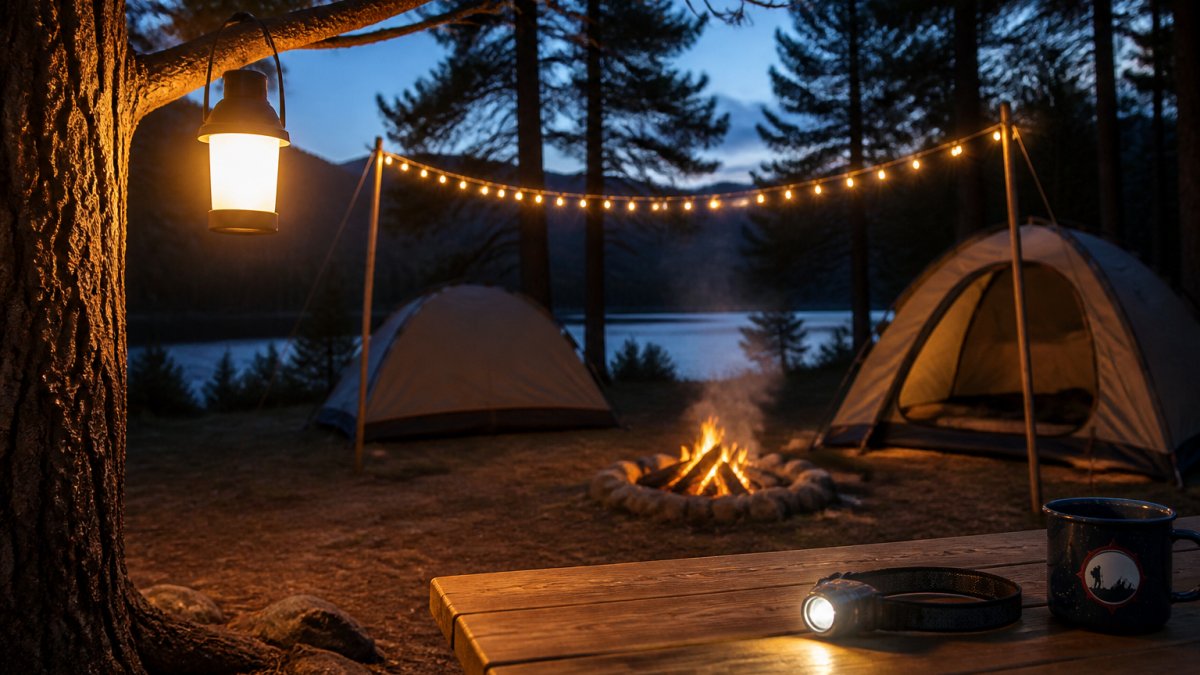
The three layers, and what each one is for
Task lighting is for cooking, reading, and repairing gear. It should be bright, directional, and close to the work surface, a headlamp or a lantern with a focused low-glare setting. You want enough light to see a cutting board clearly, not enough to flood the whole site.
Ambient lighting is for the table, tent interior, and social area after dinner. It should be soft, warm, and diffused, a lantern with a frosted globe or a string light along a guyline. The goal is to see faces and find a mug, not read a map.
Path lighting is for moving between the tent, table, vehicle, and bathroom. It should be low, warm, and pointed at the ground, a small lantern hung low, a staked string light, or a headlamp on its lowest setting. This is the layer most campers skip, and the one that prevents trips over guy lines at 2 a.m.
Matching the plan to the site
A developed campsite with a picnic table, a fire ring, and a parking pad has a different layout than a dispersed site in the backcountry. Here is how the layers map to common setups:
| Site layout | Task | Ambient | Path |
|---|---|---|---|
| Car camping with a table | Lantern on the table, headlamp per person | String lights over the table | Small lantern at the tent door |
| Tent-only weekend site | Headlamp per person | Mid-size lantern inside the tent | Headlamp on low between tent and table |
| Backpacking, dispersed | Headlamp per person | Compact lantern only if evenings are long | Headlamp on low, red mode after dark |
| RV or trailer | Lantern on the awning table | String lights under the awning | Small lantern at the step |
| Emergency outage at home | Rechargeable lantern in the main room | Battery string lights in hallways | Headlamp per person for stairs |
Activity-based placement
Cooking: put the task light on the table or hang it above the stove, not behind you, a light behind your body throws your shadow onto the cutting board.
Tent setup: do this before dark if you can. If not, use a headlamp on high pointed at the poles, not into the site. A second person with a lantern held low speeds this up.
Nighttime movement: keep one low-warm light at the tent door and one at the table. That is enough to orient you without waking anyone or ruining your night vision.
Reading in the tent: a compact lantern hung from the ceiling loop beats a headlamp, because the light comes from above and does not glare off the page.
Trip-type picks
Family car camping: one basecamp lantern for the table, one headlamp per person, and one string light set. This covers all three layers without overpacking.
Solo weekend trips: one mid-size lantern and one headlamp. The lantern handles ambient and task; the headlamp handles path and hands-free work.
Backpacking: two headlamps, no lantern unless the trip has long evenings in camp. Weight matters more than comfort here.
RV use: a lantern for the awning table, string lights for the awning, and a small lantern at the step. You have power, so runtime is less of a constraint.
Emergency preparedness: one rechargeable lantern per main room, one headlamp per person, and battery string lights for hallways. This mirrors the camping plan but scales to a house.
The point of the plan is to stop buying lights by brightness and start buying them by job.
Light Pollution, Battery Care, and Long-Term Value
Light pollution is the part of camping lighting nobody talks about, and it affects your neighbors and the wildlife around you.
Use the lowest setting that does the job. Point lights downward or shield them so they do not throw a beam across the next site. Switch to warm or red light after dark, which preserves your night vision and is less annoying to anyone nearby. A bright white light pointed into the trees does no one any favors.
Battery care is the other half of long-term value:
- Store rechargeable lights at around half charge for the off-season
- Keep contacts clean and dry
- Replace aging batteries rather than the whole light where the design allows
- Retire lights with cracked housings, since a failed seal means a failed light
Buying one well-made light that lasts several seasons beats replacing a cheap one every year. That is the whole argument for spending a little more up front.
Conclusion: Building a Lighting Kit That Works
The hard part of camping lighting is not finding a bright light. It is building a small kit that covers the tent, the table, and the path without weighing you down or dying on night two.
Survive Nation stocks outdoor lighting and emergency gear for exactly that job, with a fast, user-friendly, and customer-service-oriented shopping experience and affordable prices. Start with a rechargeable lantern, add a headlamp for every person, and finish with string lights for ambient glow. Shop now at Survive Nation and build a lighting setup you can trust on the trail or during a power outage.
Frequently Asked Questions
How many lumens do I need for a camping lantern?
For most campsites, 100 to 300 lumens handles tent interior and table tasks well. A 50-lumen setting works for reading in a tent, while 500 or more lumens suits group areas or path lighting. Look for dimming or multiple light modes so one lantern covers both. Brightness matters less than beam pattern and runtime at the setting you actually use.
Are rechargeable or battery-powered camping lights better?
Rechargeable camping lights cut waste and often include USB charging and power bank output for phones. Battery-powered models win on cold-weather reliability and long trips where you cannot recharge. Many campers carry both: a rechargeable lantern for base camp and a battery-powered backup for emergencies. Check charging time and battery capacity before you commit to one system.
Are solar camping lights worth it for backpacking?
Solar-powered lights work well for car camping and base camps where panels get direct sun. For backpacking, they add weight and depend on weather you cannot control. A small solar lantern makes sense as emergency lighting at home or in a vehicle kit. For trail use, a lightweight rechargeable headlamp is usually the better call.
What should I look for in waterproof camping lights?
Check the IP rating. IPX4 handles rain and splashes, IPX6 survives heavy spray, and IPX7 means the light can be submerged briefly. For most camping, IPX4 or better covers tent leaks and sudden storms. Also look for impact-resistant housing and a hanging hook or magnetic base so the light stays put in wind.