 blog
blog
Best Survival Gear for Long Term: 2026 Guide
Table of Contents
- Why Long-Term Survival Gear Is Different
- Long Term Survival Kit List: Core Categories That Matter
- Best Survival Food Storage for Extended Shelf Life
- Gear Maintenance Tips for Long-Term Readiness
- Psychological Resilience Gear: The Missing Piece
- Repair and Maintenance Kits: Keeping Gear Alive
- Weight-to-Durability Ratios: Choosing Gear That Lasts
- Climate and Regional Specificity: Adapting Your Kit
- Frequently Asked Questions
Last Updated: September 14, 2026
Why Long-Term Survival Gear Is Different
Long-term survival gear is equipment chosen to stay functional for months or years of continuous use, not a single weekend trip. A tent that survives three summer outings may fail after 90 nights of UV exposure, and a fire starter that works in dry conditions can quit in a downpour.
The best survival gear for long term is judged on repairability, durability, and performance when resupply isn't coming.
Three factors separate expedition-grade equipment from recreational gear:
- Service life under repeated stress, not peak performance once
- Field repairability using common tools and spare parts
- Weight-to-durability ratio, covered later in this guide
The Federal Emergency Management Agency's preparedness guidance frames readiness around sustained self-sufficiency, which is exactly the standard long-term gear must meet.
Long Term Survival Kit List: Core Categories That Matter
A long-term survival kit list organizes around seven core categories: cutting and digging tools, ignition, water treatment, food storage, shelter and bedding, navigation and signaling, and medical supplies. Each needs a primary tool and a backup, redundancy is the difference between an inconvenience and a crisis.
Cutting and Digging Tools
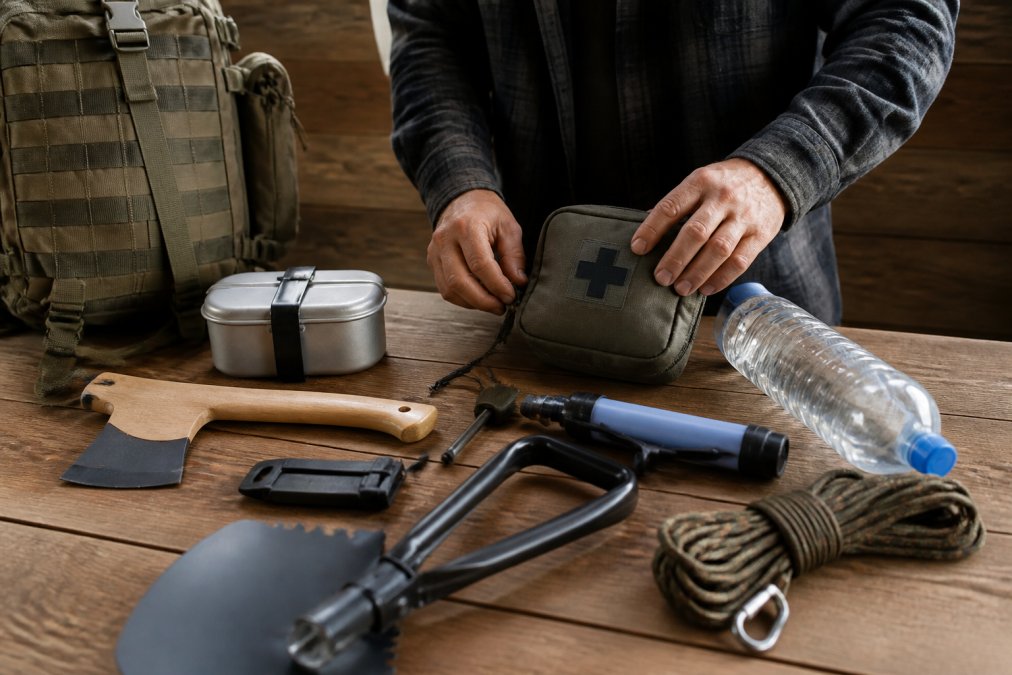
Start with a fixed-blade knife, a hatchet, and a folding shovel. Fixed-blade knives outperform folding models for batoning and prying because there is no hinge to fail. A hatchet handles firewood and shelter building; a folding shovel manages latrines, fire pits, and vehicle extraction.
What most guides miss is sharpening access: a knife you cannot sharpen in the field becomes a paperweight, so pack a diamond sharpener and a small file. For digging, choose a shovel with a locking blade and hardened steel head, since stamped metal bends under rocky soil.
Fire Making and Ignition Sources
Carry three ignition methods: a ferrocerium rod, waterproof matches, and a butane lighter. Ferro rods work when wet and last thousands of strikes; matches and lighters cover moments when cold or injury compromises fine motor control.
Store tinder separately from ignition tools. Petroleum jelly cotton balls, birch bark, and commercial fire starters ignite reliably in damp conditions. A flint and steel set is a solid backup but demands more skill than most people practice.
Water Filtration and Storage
Water treatment needs two layers: filtration for sediment and pathogens, and chemical or UV treatment for viruses. A hollow-fiber filter does the bulk of the work; tablets or a UV pen cover what it misses. Store water in food-grade containers and rotate on a schedule you track.
Best Survival Food Storage for Extended Shelf Life
The best survival food storage combines freeze-dried meals, staple grains, and canned goods in oxygen-free, moisture-proof conditions. Shelf life collapses when oxygen, heat, or moisture get in. Mylar bags with oxygen absorbers extend dry goods dramatically, but packaging is only half the equation; the other half is what you put inside and how you rotate it.
Shelf Life by Category
Shelf life varies enormously by food type and storage method:
| Food Type | Standard Pantry | Properly Packaged (Mylar + O2 Absorber) |
|---|---|---|
| White rice | 1-2 years | 25-30 years |
| Rolled oats | 6-12 months | 20-30 years |
| Dry beans | 1-2 years | 25-30 years |
| Freeze-dried meals | 5-10 years (sealed) | 25+ years |
| Canned goods (low acid) | 2-5 years | 5-10 years |
| Honey | Indefinite | Indefinite |
| White sugar | Indefinite | Indefinite |
| Powdered milk | 1-2 years | 20+ years |
These ranges assume cool, dark, dry storage. Every 10°F rise above roughly 70°F halves the shelf life of dry goods, a garage hitting 100°F in summer can cut a 25-year rice supply to under a decade.
Container Systems That Actually Work
Mylar bags are the workhorse for dry staples, but not the only option. The three container systems most long-term preppers rely on:
- Mylar bags with oxygen absorbers, Best for rice, beans, oats, pasta, and powdered milk. Use 7-mil or thicker bags, seal with a heat sealer (not a clothes iron), and add roughly 300 cc of absorber per gallon of dry goods.
- Food-grade buckets with gamma-seal lids, The outer layer that protects mylar from punctures, rodents, and light. Square buckets stack more efficiently than round ones. Do not store food directly in a bucket without an inner liner; the plastic is not oxygen-barrier.
- #10 cans, Commercially sealed cans offer the longest shelf life and best protection, but cost far more per calorie and are heavy to transport. Best for a fixed-location cache.
Caloric Density: The Number Most Guides Skip
A storage plan that ignores calories runs out early. An average adult needs roughly 2,000-2,500 calories per day, more in cold or physically demanding conditions, a one-year supply for one person is roughly 730,000-900,000 calories.
Translate that into food:
- White rice: about 1,600 calories per pound dry, roughly 500 pounds for one person-year
- Dry beans: about 1,500 calories per pound, roughly 550 pounds for one person-year
- Freeze-dried meals: typically 500-800 calories per pouch, roughly 1,000 pouches for one person-year
Staples win on cost per calorie; freeze-dried meals win on convenience, variety, and preparation speed. Most long-term plans blend both: staples for bulk calories, freeze-dried for variety, morale, and situations where fuel or water is scarce.
Rotation That Does Not Depend on Memory
First-in, first-out only works if you can tell what is oldest. Two systems solve this:
- Date-and-stack, Write the pack date on every container, then stack new stock behind old stock. You always pull from the front.
- Inventory sheet, Keep a running list of what you have, when it was packed, and when it needs rotation. A clipboard on the storage room wall beats a spreadsheet you never open.
Label every container with the date it was packed and the date it needs rotation. A sharpie mark on the lid saves you from guessing, and guessing is how stored food and water quietly go bad.
What to Store First
If you are building from zero, the order that delivers the most resilience per dollar:
- Water storage and treatment (you die fastest without it)
- Salt, sugar, and honey (indefinite shelf life, high utility)
- White rice and dry beans (cheapest calories, longest shelf life)
- Cooking oil and fats (hardest to store long-term, but essential)
- Freeze-dried meals (variety, morale, no-cook options)
- Canned goods (shortest shelf life, rotate aggressively)
Build in that order and you will have a functional food plan long before you have a perfect one.
Gear Maintenance Tips for Long-Term Readiness
Survival gear maintenance tips boil down to inspection, cleaning, and rotation on a fixed schedule, gear that sits untouched fails silently. Set a quarterly reminder to inspect every item, test every ignition source, and replace anything degraded. But a checklist is the floor, not the ceiling: long-term readiness depends on understanding how gear fails, what you can fix in the field, and what to replace before it ever gets there.
The Repairability Hierarchy
Not all gear is worth fixing. Before you pack anything, ask three questions:
- Can I fix it with tools I already carry? If not, it is a liability on a long timeline.
- Will the fix hold under repeated stress? A field repair that fails in a week is worse than no repair, because it creates false confidence.
- Is the replacement part standardized? Gear that uses proprietary parts you cannot source is gear you cannot maintain.
Rank your gear into three tiers:
- Tier 1, Field-repairable: Fixed-blade knives, hatchets, folding shovels, paracord, duct tape, sewing kits, multi-tools, ferro rods, hollow-fiber filters. These can be maintained or repaired with common tools.
- Tier 2, Bench-repairable: Tents, sleeping bags, water pumps, cookware. Fixable with a dedicated repair kit, but not with what is in your pocket.
- Tier 3, Replace-only: Electronics, UV pens, butane lighters, sealed batteries. Treat these as consumables with a known end date.
Common Failure Modes and Field Fixes
Most gear failures fall into predictable categories. Knowing them in advance turns a crisis into an inconvenience.
Cutting tools
- Failure: Chipped edge, loose handle, rust.
- Field fix: Diamond sharpener for edges; epoxy or wire wrap for loose handles; oil or grease for rust prevention. A loose hatchet head can be re-seated by soaking the handle end in water (temporary) or re-wedging with a metal wedge (permanent).
Shelter
- Failure: Torn fabric, broken pole, failed zipper, delaminated waterproof coating.
- Field fix: Tenacious tape or ripstop patches for fabric; pole splints made from a slightly larger tube and duct tape; zipper repair with pliers and a zipper lubricant (a pencil lead works in a pinch). Re-waterproof with a spray-on DWR treatment annually.
Water treatment
- Failure: Clogged filter, cracked housing, expired chemical tablets.
- Field fix: Backflush the filter per manufacturer instructions; if the housing cracks, a hose clamp and a section of inner tube can seal it temporarily. Chemical tablets lose potency over time, rotate them on the manufacturer's schedule, not yours.
Cordage
- Failure: Fraying, UV degradation, abrasion at contact points.
- Field fix: Whipping the ends with dental floss or thin cord prevents unraveling. Replace any cord that has lost more than about a third of its diameter to abrasion. Paracord's inner strands can be pulled out and used individually for fine repairs.
Fire starters
- Failure: Ferro rod worn down, lighter out of fuel, matches damp.
- Field fix: Ferro rods are consumable, track how much you have used and replace at roughly half-life. Lighters can be refilled if you carry butane; otherwise treat them as disposable. Matches should be stored in a waterproof container and replaced annually.
The Repair Kit That Earns Its Weight
A repair kit turns a broken tool into a fixable one. When resupply is uncertain, the ability to patch, splice, and reattach matters more than owning the newest equipment. A practical long-term kit includes:
- Sewing: Heavy-duty needles, waxed thread, dental floss (stronger than most thread), a thimble, and a few buttons.
- Fabric: Tenacious tape, ripstop patches, a small tube of seam sealant.
- Metal: A multi-tool with pliers and wire cutters, a small roll of steel wire, a few hose clamps.
- Adhesive: Duct tape (wrapped around a pencil to save space), a small tube of epoxy, super glue.
- Cordage: Paracord, bank line, and a few feet of snare wire.
- Fasteners: Replacement buckles, zipper pulls, grommets, and a small assortment of screws and nuts.
- Sharpening: Diamond sharpener, a small file, and a strop or leather scrap.
Cordage deserves special attention. Poly cord and paracord handle shelter tie-downs, gear repair, and hundreds of other tasks. Carry more than you think you need.
Preventive Maintenance Schedule
A working routine:
- Monthly: Inspect knife edges, hatchet heads, and shovel locks for looseness; test lighters and ferro rods.
- Quarterly: Check water filters for cracks and flow rate; rotate stored food and water by date; recharge or replace every battery, including spares.
- Annually: Re-waterproof tents and outer layers; replace expired medications and chemical treatments; inspect all cordage for UV damage and abrasion.
- Before every deployment: Test every ignition source, verify filter flow, confirm repair kit contents, and check that all Tier 3 items have working backups.
The gear that lasts is the gear you can fix. A repair kit costs little and extends the life of everything else in your pack. But the real discipline is preventive: inspect on a schedule, replace on a schedule, and never trust gear you have not tested since the last time you packed it.
Psychological Resilience Gear: The Missing Piece
Psychological resilience gear is the category almost every list ignores: the tools and routines that keep you thinking clearly under prolonged stress. Long-term survival is a mental endurance event. Boredom, isolation, and decision fatigue erode judgment faster than hunger does.
Practical items include a deck of cards, a notebook and pencil, a book on foraging or first aid, and anything that maintains normalcy. Sleep quality, a consistent routine, and a way to mark time protect your decision-making. Teams and families that practice together handle stress better than individuals who never rehearse.
Repair and Maintenance Kits: Keeping Gear Alive
The gear that lasts is the gear you can fix. A repair kit costs little and extends the life of everything else in your pack.
Weight-to-Durability Ratios: Choosing Gear That Lasts
Weight-to-durability ratio is the trade-off between how much gear weighs and how much abuse it survives. Ultralight gear saves your back on a weekend hike but often sacrifices the toughness long-term use demands. For extended readiness, lean durable unless you are carrying the kit on foot for days.
| Gear Category | Lightweight Priority | Durability Priority | Best For |
|---|---|---|---|
| Cutting tools | Titanium folders | Fixed-blade steel | Field use, batoning |
| Shelter | Single-wall tents | Four-season tents | Cold, wind, snow |
| Cordage | Thin poly cord | Paracord, utility rope | Shelter, repairs |
| Water treatment | UV pens | Hollow-fiber filters | High-volume use |
| Cookware | Titanium pots | Stainless steel | Repeated, rough use |
The right balance depends on your scenario. A vehicle kit can carry heavier, tougher gear; a backpack kit must compromise. Decide which matters more before you buy.
Climate and Regional Specificity: Adapting Your Kit
Climate and regional specificity means matching gear to the conditions you will actually face, not a generic checklist. A kit built for a humid coastal area fails in a dry, cold region and vice versa. Regional climate drives shelter, insulation, water, and food choices.
Cold climates demand insulation, wind protection, and reliable fire starting in wet conditions. Hot, arid climates prioritize water storage, sun protection, and shade. Humid regions need moisture control and mold-resistant storage. The National Weather Service safety resources and Centers for Disease Control and Prevention emergency preparedness pages both stress planning around local hazards rather than a one-size-fits-all kit.
Build one core kit, then add a climate-specific module. That keeps your base investment stable while adapting to where you actually live and travel.
Frequently Asked Questions
What are the top 10 survival gear items to carry for long-term situations?
For long-term survival, prioritize cutting tools (hatchet, multi-tool), fire starters (flint and steel), water purification (filter and storage), shelter (tent, sleeping bag), food storage (freeze-dried meals), first aid kit, navigation (compass), signaling devices, cordage, and repair kits. These cover the essentials for extended self-reliance.
How do you choose high-quality survival gear that lasts?
Look for durable materials like stainless steel, heavy-duty fabrics, and reliable mechanisms. Check customer reviews for longevity, prefer gear with replaceable parts, and consider weight-to-durability ratios.
What is the difference between a bug-out bag and a long-term survival kit?
A bug-out bag is designed for quick evacuation (72 hours), focusing on portability and immediate needs. A long-term survival kit supports extended self-sufficiency (weeks or months), including food storage, water purification, tools for shelter building, and maintenance supplies. The latter is heavier but more comprehensive.
What are the most critical survival items for long-term food and water security?
For food security, stock freeze-dried meals, Mylar bags, and oxygen absorbers for long-term storage. For water, invest in a high-capacity filter (e.g., gravity-fed), water storage containers, and purification tablets. Rotate food stocks and test water filters regularly to ensure reliability.
Long-term readiness rewards planning over panic buying. The gear that keeps you going is durable, repairable, and matched to your climate. Survive Nation stocks the essentials this guide covers, from sleeping bags and food storage to outdoor lighting, all backed by a fast, user-friendly shopping experience and a customer-service team that answers real questions. Shop now with Survive Nation and build a kit that holds up when it counts.